Plain english guide to profit and loss

Here’s our Plain English guide to profit and loss and what this report reveals about your finances.

What is profit and loss?

Your profit and loss statement is commonly called your ‘P&L’. It’s also sometimes referred to as your income statement or statement of earnings.

Your P&L is a breakdown of your company’s revenue (money coming into the company as sales and other income) and your expenditure (direct costs, overheads, expenses and other costs).

As a business, you obviously want to turn a profit and make money. Keeping a close eye on your P&L allows you to track your revenues and expenses over a set period, and look for ways to boost your profitability as a business.

How does profit and loss affect your business?

Being in control of your financial management is hugely important for any business. Your P&L is one of the main ways to track and analyse this financial performance.

To manage your P&L effectively, it’s important to focus on:

  • Revenue management – to keep your revenue (income) healthy, you need to be proactive about generating sales and monitoring your revenue streams. This helps keep your income steady and stable, while also identifying areas for growth and improvement.
  • Expense control – tracking and monitoring your operating expenses helps you spot where spending efficiencies could be made. Whether it’s overhead costs or inventory overspending, your P&L helps you spot unnecessary costs and boost profits.
  • Cost analysis – analysing your business costs can help you spot the opportunities for saving money. Whether it’s agreeing a discount for buying in bulk, or switching to a new supplier with cheaper rates, there are plenty of ways to cut costs and be more profitable.
  • Monitoring gross margin – reviewing the company’s gross margins helps you assess the profitability of each product or service. By pushing up prices, or cutting your production costs, you can boost those margins to drive up profits.
  • Financial reporting – preparing regular profit and loss statements is key to good financial management. Reviewing your P&L helps you assess the overall financial performance of the company and make better-informed decisions.

How can our firm help you with managing your P&L?

When you’re in control of your P&L, you have a tighter hold on the reins of your profitability.

As your adviser, we’ll help you run regular P&L reports as part of a monthly or quarterly package of management information. We can help you track, review and analyse your revenue and expenses to spot the best opportunities for boosting the company’s profits.

If you’d like to know more about the impact of profit and loss, we’ll be happy to explain.

Get in touch to chat about managing your P&L.

November 13th, 2023|

We’re finalists! – BSI People Skills Ltd Business Culture Excellence Awards

We’re stoked to share the exciting news that Sidekick has been chosen as a finalist for the BSI People Skills Ltd Business Culture Excellence Award! This remarkable achievement is a tribute to our extraordinary Sidekick team and the culture they’ve fostered as a collective effort. Thank you to our dedicated team members and everyone who has contributed to our remarkable journey.

And now we need your help to secure the People’s Choice award. Please vote for our video on Facebook, Instagram, and LinkedIn by liking, commenting, or sharing.

Facebook – https://facebook.com/bsipeopleskills/videos/361450542983714

Instagram – https://www.instagram.com/reel/CyueApnIL0-/?utm_source=ig_web_copy_link&igshid=MzRlODBiNWFlZA==

LinkedIn – https://www.linkedin.com/posts/cathy-sheppard-bab91b30_cultureexcellence-teamwork-peoplematter-activity-7122010991957053440-a-Cr?utm_source=share&utm_medium=member_desktop

October 19th, 2023|

Common employment agreement mistakes

Every employee in NZ must have a written employment agreement, whether they are full-time, part-time or casual.

As the fundamental legal document between an employer and an employee, the employment agreement sets out the terms and conditions of employment, establishes entitlements and expectations, and provides a reference if there are any issues down the track.

While they’re not hard to get right, there are some common errors that every business wants to avoid:

  • Not having an agreement at all – If you don’t have a written employment agreement for every employee, you could be fined.
  • Not getting the right type of agreement – If your employee’s agreement doesn’t match the reality of their work, you could face an employment dispute or other costs, including outstanding wages, holiday pay, or PAYE tax. Find out more about employment types at business.govt.nz.
  • Not complying with employment legislation – All employment agreements must have a number of basic clauses, including the names of the employer and employee, what the nature of the work is, where it is, the agreed hours, and the salary or wage rate. Not having these clauses could open you up to legal disputes and fines.
  • Shortchanging workers’ rights – Even if the employment agreement doesn’t comply with an employee’s basic rights, such as minimum wage rates, paid annual and public holidays, paid rest and unpaid meal breaks, the minimum rights are still legally binding.
  • Not following the provisions – If you fail to adhere to the employment agreement’s provisions or act in good faith, you could face personal grievance claims from employees or fines by the Labour Inspectorate.

Remember, the employment agreement is the basis of the employment relationship, so having a watertight agreement will get you off to a good start and provide an honest foundation to build on.

This article will make sure you don’t fall into the common traps when creating employment agreements.

October 19th, 2023|

How much should you pay yourself?

Being the boss means you get to make all the big decisions about your business – including how much to pay yourself in wages, salary or drawings.

As the owner, you might need to underpay yourself in the early stages of building your business, so you can reinvest the profits. But your time is valuable – and you need enough money to pay the bills. So how can you find the right level of pay? It has to be enough to keep the mortgage paid, while also building a thriving business.

If you’re trying to decide how much to pay yourself, here are a few questions to ask yourself:

  • What can the business afford? – You need to leave enough cash in the business to keep it ticking along, pay your basic costs, and meet your tax obligations. Once you’ve considered all those outgoings, how much does that leave you as a potential salary? We can help you work out what that number is, so you can establish a sustainable rate of pay.
  • What’s the market rate for your role? – What would you have to pay someone to do the work you’re undertaking in this business? Maybe you wouldn’t actually be able to find anyone to work the same long hours, but if you were hiring someone with your experience, to do the same sort of work for 40 hours a week, what would they expect to be paid? That number is a good starting point for thinking about your own salary or drawings. If you’re being underpaid, it’s time to think about ways to grow your profits. If you’re being overpaid, congratulations on building a highly profitable business!
  • Could reinvesting profits grow your income faster? – You can take all the profits out of your business, which should give you a strong and sustainable income. Or, could you reinvest your profits and grow the business faster, leading to a higher income in the long-term? You might choose to spend some of your profits on advertising, a better website, or developing a new offering, for example. Or you could pay for assistance in some area of the business. If the investment leads to higher growth, it might be well worthwhile.

We’ll help you run the numbers

We can help you figure out how much your business can afford to pay you, analyse the potential gains of a business investment, or weigh up the pros and cons of hiring someone to help you.

Get in touch, we’d love to hear from you.

October 19th, 2023|

10 hot questions to ask yourself as a business owner

Running a busy and successful business means you often don’t have the time to step back and work ON the business. This can be a challenge if your aim is to grow and scale the company.

As experienced professional business advisers, we know the value of taking the time to ask yourself some pertinent questions. Holding yourself and the business to account is something we can help with. And there’s never a bad time to pose a few questions and gauge where you’re at with your planning, strategy, financial management and personal goals as an entrepreneur.

We’ve pulled together 10 hot questions to ask yourself as a business owner.

1. Can you explain why a customer should choose your brand over another?

Knowing your value to a customer is vital if you’re going to market your offering in the most effective way. Think about why your brand stands out in the marketplace, and what opportunities and threats exist. This is the fastest way to tailor your brand to meet customer expectations.

We can help you by running a SWOT-based analysis of your business.

2. How happy is your workforce?

Your people are such a vital asset, but they won’t work well if they’re dissatisfied and disengaged from your business values. Ask yourself, are your employees motivated and engaged by your mission? Is there anything you can do to boost this engagement?

We can review your people strategy and the staff benefits you offer to your employees.

3. Are you meeting your cashflow goals?

Are there specific costs or inefficiencies that are holding you back from achieving a positive cashflow position? Ask yourself if your financial management is up to scratch. Identify your failings and tighten up your cash process.

We can review your cash management and look for efficiencies and cost-saving opportunities.

4. What keeps you awake at night?

It’s a stressful role being the boss, and there’s likely to be a lot playing on your mind. Consider whether there are any recurring business issues that are holding you back, or unexpected pitfalls that have appeared along the course of the business journey.

We can offer you seasoned advice whatever the issue, with resolutions to ease your worries.

5. Are you embracing everything that tech and AI has to offer?

Technology is moving fast with AI solutions and digital systems now an integral part of many business models. But are you doing enough to bring your business into the digital age? Are there tasks could you automate, or processes you could streamline?

We can suggest a suite of apps, software tools and digital solutions to boost your business.

6. Is growth part of your business strategy?

Not all businesses are focused on growth, but outlining your key goals around growth is an essential part of your business strategy. Ask yourself whether you want to scale at speed, or grow organically. Or whether you’re happy to be a boutique business that keeps things small.

We’ll help you define your growth goals and build a strategy that aims for success.

7. Do you have the numbers you need at your fingertips?

So much of what you do as a business is driven by data. But are you getting the overview you need of your important business metrics and key financial numbers? Think about where you need detailed data and metrics, and how this could put you in better control of the company.

We can help you expand your reporting and management information, so you have a better eye on performance, spending, cashflow and sales targets etc.

8. Have you identified your ideal customer?

Identifying your ideal customer is something every startup and new business should do. But when was the last time you updated your ideal customer outline? Think about who you’re selling to, how this audience has evolved and whether they are still the right customer to target.

We can run detailed customer profiles to help you pinpoint the best customers to target.

9. Have you thought about where your business will be in five years?

When the business is busy, the temptation is to focus on the now and to put your energy into fighting the most pressing fires. But without a forward-looking focus, you can lack direction. Ask yourself where you want to be in five years and how you plan to achieve these goals.

We’ll help you create a detailed five-year plan, to give your journey more impetus and direction.

10. Are you planning for your own financial future?

You obviously spend a lot of your time thinking about your business – but how much time have you spent considering your personal financial future? Think about your life goals and how you plan to fund them, and where this money is likely to come from.

We can advise you on wealth planning, tax planning and the advantages of good all-year-round financial management.

Talk to us about running a health check for your business

If these questions have got you thinking about your business efficiency and growth plans, that’s a good thing. If you’d like to take this process further, we’d advise running a detailed health check for your business and your personal finances.

Book a meeting with us to talk through your goals, aspirations, challenges and strategy, so we can help you take the next step in your journey to entrepreneurial success.

Get in touch to book a health check.

October 19th, 2023|

What will a National-led government mean for your taxes?

We don’t yet know exactly how the new National-led coalition government will be formed. But we do know that National pledged to make some major changes to tax if it came into power. Here are some of the changes that could affect you:

Tweaks to tax brackets

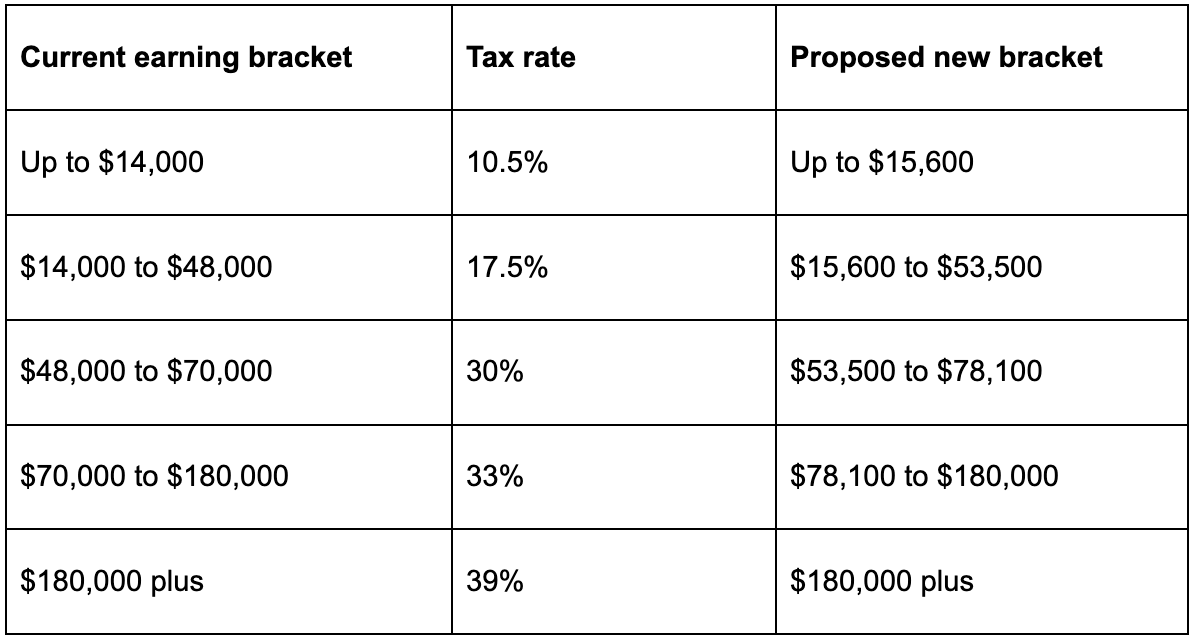
National has proposed changes to tax brackets, designed to adjust for inflation and boost incomes:

Screenshot 2023-10-16 at 8.19.17 PM

Restored interest deductibility on rentals and a two-year bright line test

On investment properties, National has said it will gradually reinstate 100% interest deductibility. This will happen in increments over the next three years. The bright line test, which is currently set at 10 years, would be reduced to two years.

FamilyBoost and Working for Families

FamilyBoost is a new initiative that would provide a rebate for childcare costs of up to $150 a fortnight, reducing for higher incomes.

National has also proposed an increase to the existing Working for Families in-work tax credit. Together with the new tax brackets, National says a couple with young children, with a household income of $120,000, would have up to $250 a fortnight more in hand.

No more clean car discounts

National says the clean car rebate and feebate system will be scrapped at the end of 2023. Instead, the party plans to support the transition to EVs by expanding the public charger network, adding 10,000 extra charging stations by 2030.

You can read more about National’s tax plan here.

ACT and NZ First may yet have their say on taxes

ACT has its own tax plan which includes a two-bracket income tax system, and the party will have an influence on the final decisions regarding tax brackets and rates. It’s not yet clear whether National and ACT will need to strike a deal with New Zealand First, but if they do it may mean further negotiations on tax changes.

We’ll keep you posted on the changes that will impact you

We will be watching closely as the new Government makes decisions on taxes – and we’ll keep you updated. If you have questions about what new taxes could mean for you, your trust, or your business, we’re here to help.

Drop us a note or give us a call, we’d love to hear from you.

October 19th, 2023|

Getting in control of your inventory – to unlock efficiency and cashflow

As a manufacturing or product-based business, efficient stock management is a big part of running a smooth operation. But the way we manage stock and inventory has changed radically in the past decade, in no small part due to the evolution of inventory technology.

With cloud-based inventory management systems now available for even the smallest business, and direct integration with your accounting and finance systems, there’s no excuse for not being in control of your inventory and stock purchasing.

But with the ups and downs of the global supply chain in 2023, what can you do to get more from your stock, your inventory systems and the capital locked up in these stock assets?

New ways to enhance your inventory management

With today’s inventory management solutions, it’s never been so easy to have complete oversight of your stock levels, popular products and restocking information. Data is king and the more information you have at your fingertips, the easier your stock management will be.

Let’s take a look at some important ways to get more from your inventory management:

  • Use the latest inventory management systems – when you use cloud-based inventory management software you get the benefits of real-time tracking, accurate forecasting and seamless inventory control. This gives your operational efficiency a boost, reduces errors and optimises your stock levels, all of which can make your business more efficient, productive and profitable.
  • Integrate your inventory app with your finance and business platforms – by integrating inventory management tools with your finance and business platforms, you streamline your workflows, automate key processes and synchronise your stock data. With all this info at your fingertips, you can make better business decisions, cut down the time-consuming manual tasks and enhance the performance of the business.
  • Keep your stock management lean and agile – embracing lean stock management means only producing or ordering in the stock you actually need. This helps you to optimise your inventory levels, reduce carrying costs, minimise wastage, avoid stockouts and align supply with genuine customer demand. This cuts unnecessary waste and spending and makes your stock operations far more effective and profitable as a result.
  • Sell off your surplus stock to free up cash – if you have stock sitting idle, why not sell this dead stock at a discount to turn these assets into cash? Your inventory management software can quickly identify surplus stock, allowing you to run targeted sales strategies such as discounts, marketing campaigns or customer events to liquidate excess stock. This is a fast way to generate additional revenue and boost your current cashflow.
  • Reevaluate how big your warehouse capabilities need to be – could you move to a smaller warehouse facility to save cash and be more effective? The data you get from your inventory management software gives you deep insights into your stock movement. This gives you the evidence you need to decide whether downsizing could reduce overhead costs, enhance your operational efficiency and improve profitability.

Talk to us about getting in control of your inventory

Being the master of your inventory and stock management is an incredibly valuable skill for any product-based business. If you want to get in complete control of your inventory, switching to a modern cloud-based inventory management solution is an investment you won’t regret.

We’ll advise you on the best inventory software tools and how they integrate with your accounting and business platforms. We’ll also share the best tips on how to improve your operational efficiency, stock management and overall revenue generation.

Get in touch to upgrade your inventory tools.

September 22nd, 2023|

How running a lean business model improves your cashflow and efficiency

Keeping your operational expenses under control, while also remaining efficient and meeting customer demand can be a challenge – one that can catch out many new business owners.

This is why running your enterprise using a lean business model is such a good idea. By keeping operations, stock and processes to a minimum, you reduce your outgoings, speed up efficiency and improve your cash position. But how does the lean model work?

5 core elements of a lean business model

In essence, a lean business model aims to eliminate waste in your operational and product manufacturing processes, while still allowing you to meet your customers’ needs.

Originally a methodology that came from the Toyota Motor Company in the 20th century, the aim of lean manufacturing is to cut back the processes to the bare minimum. This helps you streamline the production of goods, cut your operational expenses and still meet the demands of your customers – running the whole organisation in a lean, efficient and profitable manner.

Some core element of a lean model include:

  1. Cost efficiency – cutting waste is central to the lean methodology. Applying lean allows you to reduce waste in the manufacturing process and minimise any unnecessary spending. This allows you to optimise your resources and allocate funds strategically.
  2. Increased agility – with a lean approach in place, it’s far easier for the business to be both agile and flexible. This makes it easier to respond quickly to market changes, customer needs and emerging opportunities you spot in your sector.
  3. Enhanced customer focus – promoting value is another core element of lean. By eliminating non-value-added activities, you can prioritise customer satisfaction and deliver tailored products or services that meet your customers’ exact needs.
  4. Streamlined processes – lean methodologies streamline your workflows, reduce bottlenecks and enhance your overall operational efficiency. This all leads to improved productivity and shorter lead times, helping you quickly deliver your product to market.
  5. Sustainable growth – running a lean business model promotes long-term sustainability. There’s a continuous focus on improvement, adaptability and financial stability, all of which helps to make you exceptionally competitive and ready to grow at pace.

Talk to us about implementing a lean strategy

If you want to turn your manufacturing business into a cost-effective, scalable enterprise, moving to a lean business is a big step in the right direction.

Talk to us about your current production and operational strategies. Let’s see how switching to a lean methodology will set you on the path to a more efficient and profitable future.

Get in touch to talk about lean strategies.

September 22nd, 2023|

Sidekick Conference 2023 – Hanmer Springs

Last week, the entire Sidekick Group traveled from all corners of the South Island and met up in Hanmer Springs for our annual conference!
Day 1 kicked off with the directors arriving early for their directors’ conference before the team arrived in the afternoon. After some downtime and exploring Hanmer, everyone met for a team dinner at Fire & Ice, sponsored by Smartly New Zealand.
Day 2 kicked off bright and early with a team breakfast before a group update presented by the Sidekick Group operations manager, Julie Copland. This was followed by a presentation from our guest speaker, Kendall Flutey, CEO of Banqer. Kendall shared with the team the story behind Banqer and announced Sidekick’s community partnership with Banqer moving forward! After some much-needed morning tea, the Xero Team presented to the team on the “Future of Accounting,” and, in particular, the role AI may have. This was followed by Mark Jenkins from the Gap speaking to the team about how little things every day have taken them “From Good to Great.” The afternoon activities began with the team splitting into groups and heading to pre-chosen activities. With Jet Boating, Quad Biking, Rafting, Mountain Biking, and Massages on offer, there was no shortage of options. A massive thank you to Figured for sponsoring these activities! We then ramped up into the Sidekick Awards evening, Sponsored by The Back Room Outsourced Professionals (which we’ll share the pics of in a separate post), where we celebrated the internal success of individuals and offices within the Sidekick Group.
Day 3 wrapped up with a sales training masterclass presented by Richard Wheeler before the team split off for either a walk up Conical Hill or a relaxing swim in the Hanmer hot pools before heading home. Coming together once a year like this is so important in building connections across the group and continuing to develop the fantastic team culture we’ve already built here at Sidekick. Thank you to everyone in the Sidekick Group for coming along and, in particular, to our conference sponsors Xero, Smartly New Zealand, Figured, and The Back Room Outsourced Professionals.
Craig from Tasman took some amazing photos over the course of the conference – check out a few of the highlights below!
September 22nd, 2023|

Have you got a plan for growth in your business?

Growth doesn’t need to mean more risk, more hours, and more headaches.

It may be as simple as identifying where the opportunities for growth are in your business and industry. Once you’ve done this you can establish what you and your team are going to have to do in order to maximise these opportunities, and how you will navigate the likely obstacles.

Here are a couple of tips to get you thinking about growth:

  1. Do an audit to document your growth over time. Analyse all the information you have to understand how you got to where you are right now. This will help you to plan for future growth.
  2. Next, put a one-page plan together with the big objectives and what you’ll realistically need to do in order to achieve them. (identify the tasks and people)
  3. Establish some key performance indicators to keep the momentum up and visit these regularly to ensure you’re on track.

As a business owner, you can get bogged down in the demands of day-to-day business. Taking time out of the business can give you some much-needed perspective. We can help build your business plan and identify the steps you’ll need to achieve it.

Business growth can be perceived as something scary, but when you have a plan and it’s done right, it can be very motivating and rewarding.

With a bit of planning, the right systems, people, and resources, there is a tremendous opportunity to grow and scale your business to the next level to hit your growth targets.

We can help you get started. Contact your local Sidekick office today and we can help you ith your business plan for 2023!!!

August 15th, 2023|

Which business expenses can you claim against tax?

Incurring expenses are an unavoidable fact of running a business. But which expenses can you claim tax deductions against and which don’t meet the tax-free criteria?

Here’s our lowdown on which expenses you can claim against tax.

Which business expenses can you claim deductions against?

If your business expense is directly related to earning your assessable income then you should be able to claim a tax deduction against this particular cost.

For example, everyday business expenses that you may be eligible for include:

  • vehicle expenses, transport costs, and travel for business purposes
  • rent paid on business premises
  • depreciation on items like computers and office furniture
  • interest on borrowing money for the business
  • some insurance premiums
  • work-related journals and magazines
  • membership of professional associations
  • home office expenses
  • work-related mobile phones and phone bills
  • stationery
  • work uniforms
  • tax agent’s fees.

This is good news for your operational spending, your tax costs, and your ongoing cash flow position. The more deductions you can claim, the smaller your tax bill will be. The amount of a deduction (and when you can claim it) will vary, based on the type of expenses you’re claiming. You can find out more on the Inland Revenue Department (IRD) website here.

On the whole, though, there are three basic rules for checking that your expense claim is a valid business deduction – and that it won’t be challenged by the IRD.

  1. The expense must have been for your business, available as an allowable deduction, and not for private use.
  2. If the expense is for a mix of business and private use, you can only claim the portion that is used for your business.
  3. You must have records to prove that the expense was incurred.

Which business expenses can you NOT claim?

As we’ve explained, you can claim a deduction against most business expenses that are incurred as part of your day-to-day revenue-generation activities. But there are some business expenses you cannot claim against tax.

These non-tax-deductible expenses include:

  • The principal portion of loan repayments.
  • Speeding tickets or parking fines relating to your own or business vehicles.
  • Any penalties you’ve incurred from the IRD relating to late filings or late payments.
  • Purchases of new equipment, machinery, or plant, although it’s possible that these assets may be depreciated over time.
  • Insurance premiums for life insurance, accident insurance, personal sickness, and mortgage protection insurance.
  • Any costs you’ve incurred in the initial stages of setting up your business.
  • Most clothing, footwear, and eyewear are not deductible. But if the clothing is required for the role, i.e. uniforms or safety boots etc, then it may be tax deductible.
  • Legal costs relating to any capital acquisitions you make

Talk to us about reducing your business expenses

This isn’t an exhaustive list of tax-deductible expenses. There will be various ways to claim your operational expenses against the relevant reliefs and incentives offered by the IRD.

If you’re looking to cut back your costs and improve your tax efficiency, we can help. Talk to us about your regular operational expenses and tax costs and we’ll work with you to find the important reliefs, incentives, and allowances that can be claimed.

Get in touch to start reducing your expenses.

August 15th, 2023|

Updates to ACC Invoices


Updates to levies on overseas income

Until now, ACC hasn’t been able to routinely include this income in levy calculations because it was combined with non-ACC leviable foreign earnings as part of individual tax returns. Inland Revenue can now provide us with more detailed overseas income information, so we’re obliged to levy this income. This change will impact 2023 ACC levy invoices and will include earnings received between 1 April 2022 – 31 March 2023.  It does not impact:

  • an employee of a New Zealand company, including as a shareholder-employee. They’re levied on their income regardless of whether their work takes place overseas.
  • New Zealanders receiving passive income, such as pensions, from overseas sources.
  • self-employed people who file IR3NR non-resident returns.
August 15th, 2023|

Why your accountant is the mentor you didn’t know you needed

A business mentor can provide guidance and support, so you make the right decisions and stay focused on the end goal as a business owner. They can also help you move forward in your career by providing advice and feedback on what steps to take to reach the pinnacle of success.

But have you ever thought of your accountant as a mentor?

Why your accountant is the ideal mentor

Having someone who understands your business journey is incredibly important. You might see an accountant as someone who files your tax returns. But, in fact, we’re experienced business owners, with access to a significant network of other business professionals.

An accountant can be the mentor you didn’t know you needed. No-one knows your business better than us, so we’re perfectly placed to offer you advice, guide your business journey and help you push your skills and capabilities as a business owner.

As a mentor, an accountant will:

  • Expand your knowledge as an entrepreneur – as business owners, we have the knowledge and experience to help you move your business forward. And we can work with you to expand your leadership skills, business thinking and entrepreneurial ideas.
  • Be a shoulder to lean on – we’ll offer 1:1 mentoring sessions where we can listen to your unique worries and concerns as a business owner. Having someone on the same page to listen and empathise is vital for your business and your own mental health.
  • Guide the important elements of your business – we’ll help you manage and improve your business strategy, planning and decision-making skills. We’ll also provide the management information systems you need to guide your finances and planning.
  • Keep your finances on track – we’ll show you how to maximise profits, reduce costs, and make better financial decisions. We’ll also help you plan your own personal wealth and tax strategies, so you can achieve your own entrepreneurial goals and lifestyle.
  • Introduce you to a broader business network – we work with hundreds of other business owners across a range of industries. This means we can link you up with other entrepreneurs and founders, so you have a network of other like-minded individuals to connect with. This can be vital when brainstorming and benchmarking, or if you need to talk to someone who understands the specific pain points you’re experiencing.

Having someone to guide your business journey can be invaluable. A business owner must grow and evolve along with their business, and having regular mentoring catch-ups is the ideal way to progress, offload your concerns and look for new inspiration.

If you want to grow as an entrepreneur, please come and talk to us about our mentoring services and how we can guide your business future. 

July 18th, 2023|

Keeping your business cash liquid – the difference between cashflow and profit

The foundational goal of any business is to make a profit. As a business owner, that’s one of your key financial aims – to make enough sales, at a big enough margin, to generate profit from your enterprise. But how does profit differ from cashflow? And why is cash king?

How do profit and cashflow differ?

To really understand the difference between generating profit and managing cashflow, we need to look at what both these terms mean. You might think that delving into the accounts is a job for your adviser, but being in control of your profit and cashflow is an invaluable business skill.

Let’s take a look at the differences:

  • What is profit? – Profit is the surplus that’s left from your income once you’ve paid your expenses, supplier bills and tax etc. It’s driven by creating a profit margin and generating value from your products and/or services.
  • What is cashflow? – Cashflow is the ongoing process of ensuring that the business has the available cash (or ‘liquid’ cash) needed to operate. This provides the money needed to trade, to pay suppliers, to cover wages or to buy raw materials etc.

Why is positive cashflow so important?

‘Cash is king!’ may be a cliche these days, but it’s a maxim which underpins any successful business model. Yes, it’s great to make a profit at year-end, but if you don’t look after your cashflow then the business may not survive as long as the end of the year.

What’s needed is good cashflow management to enhance your financial health. And without a careful eye on your cash numbers, things can quickly go awry.

A business can generate high revenues and big profits, but still be cashflow poor. In other words, it can have profits at the end of the period, but have very little liquid cash to fund it’s day-to-day operations over the course of the period.

Talk to us about improving your cashflow management

Good cashflow management is all about being in control of your cash inflows (income you’re generating) and your cash outflows (what you’re spending). To achieve ‘positive cashflow’ you need to proactively work to keep your inflows higher than your outflows.

As your adviser, we’ll help you set up detailed cashflow reporting and forecasting, so you can keep the business in that ideal positive cashflow position. And we’ll also look at key steps for keeping your revenues high, margins profitable and meeting your financial targets.

Get in touch to talk through your cashflow management. Book a meeting here

July 18th, 2023|

5 questions to ask when you are buying a business

Purchasing an existing company is a great way to expand your business empire. You can buy out a close competitor, or dip a toe into a new industry and expand your reach as a business group. But whatever the reason for the acquisition, you need to ensure you’re not buying a lemon!

Doing your research is a crucial part of the purchase process. As is asking some probing and insightful questions to help you determine if this acquisition is a good (or bad) idea.

Questions to ask before you make an offer

Buying another company is a major business decision. It’s a large outlay of capital and a big responsibility to take on. If you’re going to take the leap, it’s important to make sure the company in question is stable, well-managed and has a good future ahead of it.

Here are five vital questions to ask before entering into a purchase:

  1. Why is the business for sale? There are many reasons why an owner might want to offload a company, not all of them good. Their sales may be dropping, they may have rising debts, there may be internal problems with staff or the market for their product/services may be coming to an end. Find out why, so you don’t buy a clanger.
  2. Is this a good industry to step into? Do your research on the industry, competitors, and marketplace that the business currently trades in. It’s important that you step into an industry sector that has potential for sales, growth, stable revenues and potential profits. With volatile markets post-pandemic, looking at predictions and forecasts for your chosen industry niche makes good sense and helps you make an informed decision.
  3. Have you done your due diligence into the business? Do your due diligence to make sure there are no financial, legal or HR skeletons in the cupboard that may jump out to surprise you. Is there an unpaid tax bill? Are there loans that are being defaulted on? Are there any legal cases being brought against the company? Has the business filed all its returns and accounts? As the new owner, any of these issues become your responsibility, so you want to check out the company’s records and history in as much detail as possible. This will prevent some major headaches further down the line.
  4. Does it have an existing business plan? You’ll need a business plan that takes the company forwards and gives you a pathway for your next steps as the owner. Is there a business plan you can use? When was the plan last updated? How well are they tracking against the milestones in that original plan? No business plan is written in stone, so you’ll almost certainly need to review, update and refine this strategy post-acquisition.
  5. Are your management team and staff up to scratch? When you buy the business, you’ll usually also be inheriting the team behind that company. Do you have a management team with the skills, experience and motivation that’s needed? Are your employees engaged and do you have a big enough team to meet your own goals for the business? This team will be vital to your future success, so you want the best possible people and talent behind you as you steer a new course for the company.

Talk to us if you’re considering buying a company

Purchasing a company can be a complex and protracted process, even once you’ve completed all your due diligence and background checks. If you’re in the market for a business acquisition, do come and talk to us, so we can help you sort the top deals from the big risks.

We’ll help you complete the relevant checks and will work with you to create a new business plan and strategy that’s designed to turn your new purchase into a business success.

Get in touch to talk through your acquisition plans. Book a meeting here

July 18th, 2023|

5 ways to ensure you get paid on time

Worrying whether customers will pay you on time is a continual concern for business owners.

Late payment can lead to cashflow issues, unpaid supplier bills and the need to dip into your own pocket to cover your operational expenses. If you can improve the speed and likelihood of customers paying on time, that’s good news for your accounts receivable targets and the company’s overall liquidity and cashflow position.

Speeding up payment times

A sale is not a sale until the customer has actually paid you. Whether you’re an online business taking payment through your website, or a B2B company that sends out monthly invoices, you need the comfort of knowing that payment will be fast, smooth and frictionless.

Here are 5 tips for making sure that customers pay you as seamlessly as possible:

  • For eCommerce businesses, offer payment gateways to simplify payment – when a customer gets through to your checkout, it’s vital to make payment as easy as possible. Some customers may prefer to pay on a card. But offering a choice of payment gateways gives the customer more options. Instead of forcing customers down one route include payment gateways like PayPalStripeApple Pay or Google Pay.
  • For companies using e-invoicing, put payment buttons on your electronic invoices – if you send out e-invoices to your customers, including payment buttons makes settling your bill as easy as clicking that button. A payment button that’s linked directly to Paypal or Stripe removes several steps from the payment process. It’s straightforward and quick, getting you your cash without the hassle of direct credit payments payments or transfers.
  • For businesses offering subscription services, automate those customer payments – when you’re offering a recurring, monthly service, you don’t want the hassle of sending out those invoices and getting involved in cash collection. Think about automating the creation of recurring invoices in your accounting software, and get your customers to sign up to a Direct Debit platform, like GoCardless. Money is taken automatically on a pre-agreed date and the transaction matched in your accounts.
  • For retail companies, use card readers that sync with your accounting software – if you’re running a busy cafe or retail space, your customers just want to tap their card and go. Integrating your card reader with your cloud accounting software removes all the tedious data entry and adding up of receipts. With a direct EFTPOS and your accounting platform, all the data is shared automatically.
  • For all B2B businesses, send your invoices out as early as possible – the sooner you issue an invoice, the sooner the due date will come around. If you’re working on a project basis, split the fee up into chunks and invoice out at key milestones throughout the project. It’s also a good idea to make your payment terms clear and enforceable on every invoice. Payment within 14 to 30 days from the invoice date is a good standard to aim for (though 60 days, or even 90 days, is possible in some industries).

Talk to us about speeding up your payment times

Fast payments improve your cashflow position and remove the need for time-consuming and stressful debtor chasing. By following these five tips, your customers have the smoothest route to paying you, and you get the cash that’s owed to you ASAP.

We’ll help you review your payment process and cash collection to look for the main areas where you can make improvements. Book a meeting here

July 18th, 2023|

Nearly half of Kiwi small business owners aren’t paying themselves

Tight cash flow negatively impacting the wellbeing of Kiwi small business owners

Wellington — 12 July, 2023 —Xero, the global small business platform, today released new research revealing New Zealand small business owners are forgoing their pay cheques, increasing prices, and cutting costs to combat cash flow struggles.

The report titled ‘Money Matters: navigating the impact of economic conditions on the cash flow of New Zealand small and medium-sized businesses’ surveyed businesses on their perspectives and behaviours on cash flow management.

It found 46% of business owners and 60% of sole traders aren’t paying themselves in order to keep their business running.

Additionally, more than half of Kiwi small businesses (52%) have increased prices to cover the cash flow challenges, while a similar proportion (48%) have sought to review and remove costs.

Xero New Zealand Country Manager, Bridget Snelling, says these insights indicate the significant financial stress many small business owners are facing, which is having a negative impact on their emotional and physical health.

“Cash flow is one of the biggest challenges small businesses are facing. When you add in inflation, climbing interest rates and reduced spend from consumers, small business owners are walking a tightrope every day,” says Snelling.

“When small business owners experience cash flow issues one of the first things to go is their own pay, followed by an inability to pay suppliers which has a ripple effect throughout the economy.”

“It’s a systemic and volatile cycle, which sees business owners dipping into their own personal savings, working unattainable hours, and ultimately sacrificing their emotional and physical wellbeing to stay afloat.”

When asked about the emotional and physical impacts of cash flow management, business owners reported feeling stress (80%), anxiety (70%), trouble sleeping (60%) and losing time with friends/family (47%) over the past 12 months.

The report also found 94% of small business owners not achieving their business goals, and 90% of those who are less confident that they will meet their financial obligations are suffering from stress.

“These findings reflect how closely business goals and financial health are connected to small business owners’ personal stress and anxiety,” says Snelling.

Small businesses also called out inflation and its impact on cash flow as a major hurdle, with 48% saying it had a high impact on their cash flow management over the past six months.

Late payments costing small businesses

Late paid invoices are one of the biggest contributors to small business cash flow troubles. Last year, Xero research revealed late invoice payments were costing Kiwi small businesses $456 million annually.

“Getting paid on time is crucial for small business operations. Unlike large businesses, SMEs don’t typically have the working capital available to manage the sometimes ridiculous time between doing the mahi and getting paid for it,” says Snelling.

“Ultimately, we need bigger businesses to pay their invoices on time. Xero challenges all businesses to commit to paying invoices within 10 working days to help strengthen the New Zealand economy while supporting suppliers and customers in the small business community.”

Digitalisation a key step to improving cash flow management

While some small business owners are using management tactics effectively such as setting up direct debits (46%) and using accounting software to track payments (45%), there is still plenty of opportunity to tap into digital tools to help manage cash flow.

“Utilising digital tools for planning and forecasting helps business owners anticipate periods when cash flow often dips into the red, and adjust how they operate to improve their monthly cash flow position accordingly,” says Snelling.

“The right digital tools can also directly help getting paid faster. This starts with technology that allows you to invoice as soon as a job has been completed, organise automatic follow ups when payments are missed, and also includes features like ‘pay now’ on all invoices to provide organisations with more ways to pay instantly.”

“Small businesses should also be registering their interest for eInvoicing, a technology that will help improve payment times by greatly increasing accuracy and security while reducing human errors.”

If your wondering what to do next? Or have any questions about cash flow in your business call your local Sidekick office or book a meeting here

July 18th, 2023|

Fonterra Co-operative Difference

Consumers and customers want to know that their food choices support a sustainable future. The Co-operative Difference has been created by Fonterra to help farmers know what is expected of them, both today and in the future. It is a way of recognising and rewarding those farmers that produce high-quality milk in a more sustainable way. This is how Fonterra can remain globally competitive.

From June 2021, a portion of the milk payment is influenced by a supplier’s progress under Fonterra’s “next steps”. Suppliers can get up to 10 cents per kg of milk solids premium for their milk.

There are three levels of achievement.

1. Te Putake – The start of the journey focus is on looking after the people, animals, environment, and Co-op.

  • People – Complete Dairy NZ Workplace 360 assessment, achieving 100% on the foundation level. If they do not employ staff, then there is a smaller set of questions around farmers and visitors’ safety.
  • Animals – Must have Animal Wellbeing Plan developed with their veterinarian covering specific topics.
  • Environment – Must have a Farm Environment Plan in place with 3 out of 5 key practices being achieved.
  • Co-op – To achieve this, farmers need to keep full and accurate Farm Dairy Records and submit them online by 30 June each year.

Once achievements are gained in the focus areas, farmers will then receive 7 cents per kgMS on all milk supplied during the season.

2. Te Puku – The mid-point This is all about the quality of the milk supplied. Milk quality excellence must be achieved on at least 30 days during the season. Farmers will receive an additional 3 cents per kgMS on all milk supplied during the season.

3. Te Tihi – The summit This celebrates those suppliers that consistently deliver highest quality milk. To achieve Te Tihi, the milk supplied to Fonterra must be of an excellent standard for 90% of the days. There is no additional payment for this.

Accounting Treatment

This payment will be on the milk statement and will need to be treated the same as the rest of the milk payment. But we do need to be careful if completin budgets or tax forecasts for the year to find out if they are receiving this additional payment.From our experience, most farmers were last year still working towards getting these steps in place.The payment is made in the final retro payment for the season and would have been received in late September. As many farmers are still working their way through the requirements, the amount received by most farmers won’t have been significant.Other farmers have done their own cost benefit analysis and have decided that the additional 10 cents of the Co-operative Difference is not worth the effort, especially while the current Fonterra pay-out is looking to be $9.15 ($9.25 if the $0.10 premium is added). For many, an additional 1% payment isn’t worth the additional work.Although the Co-operative Difference payment of 10 cents isn’t significant, it opens the door for Fonterra to increase the amount in future as they look to actively encourage farmers to meet these targets.It will also depend on whether Fonterra can monetise this added value.

June 21st, 2023|

Do you need to improve the cash flow position for your business?

Keeping on top of the financial management of your business can be hard work. It’s possible to have a profitable business that is struggling to find the cash flow to pay expenses and fund growth. Likewise, you could have positive cash flow but are not turning a profit, particularly if you are scaling.

Turning a profit is at the heart of running any successful company But without an even and predictable flow of cash into the company, you can’t cover your overheads, you can’t pay your employees and you can’t run your day-to-day operations – let alone think about expanding and growing the business.

In the end, you need both. But if you’re going to be in control of your financial destiny, it’s important to get your head around the important process of cash flow management.

Let’s look at some of the key things to understand about your finances:

  • Profit is a by-product of a successful business – as the owner, you want to make profits, but profitability isn’t the only goal. A business can easily be profitable, but also be highly unstable in the longer term. What you want is stability and consistent revenues.
  • Cashflow keeps your business alive – good revenues (income) serve to bring cash into the business. Without cash to cover your operating expenses, you have no means to keep the lights on in the business. So cash really is king!
  • Know your cost base and overheads – the flipside of your cash flow position is your costs. In an ideal world, you want more cash inflows than cash outflows, so it’s important to know your expenses and costs and to manage them carefully.
  • Be proactive about spend management and easing expenditure – if you can take action that reduces your spending, that is hugely positive for your cash flow position. Choose cheaper suppliers, negotiate better deals and bring that cost base down.
  • Drive more revenue, through increased sales and marketing activity – if you can increase your revenues, you also boost your cash flow. So it’s important to be proactive about running targeted sales and marketing campaigns to increase your sales.
  • Keep the cash flowing and the profits take care of themselves – if you achieve the ideal cash flow position, the company sits on solid financial foundations, the cash is there for investment and the business can grow. It’s that simple.

Talk to us about improving your cashflow management

Whether you’re new to running a business, or a seasoned owner who needs some financial support, we can give you the cash flow advice you need.

We’ll review your finances, delve down into your cash flow, and will come up with key ways for you to increase your cash income and reduce your cash expenses. It only takes a few small changes to achieve a far better cash flow position for your business – helping you maintain positive cash flow AND generate profits.

June 21st, 2023|

Stressing about your work/life balance?

Trying to get perfect the work/life balance can be a cause of stress in itself. If you are feeling the strain of building your business and maintaining your life the good news is that stress and a productive existence can go hand in hand. Be mindful and you can find the balance that’s best for you.

How much stress is good for you?

The Yerkes-Dodson law shows that an individual’s performance increases with stress (arousal) until cortisol levels get too high and then decreases again just as sharply – the secret is to stop your stress levels sending you down the other side of the bell curve. How much is too much varies for everyone but by understanding and managing your stress levels you can use them for good.

How to manage your stress

  • Take Control – Feeling in control can decrease stress from negative levels by presenting the stress causes as surmountable challenges. Get a handle on your project, your tasks or your day by breaking them down into achievable goals and making choices about what to prioritise
  • Get positive – Your perception of your stress is important, rather than leading to panic and inertia recognise the first quickening of your heart rate calmly as powerful, making you more alert and capable
  • Connect – Social support reduces stress so good relationships within a team and the wider office environment make everyone more resilient to stress
  • Exercise – A good workout reduces bad stress and is good for the brain as well as the heart and lungs.
  • Sleep – Poor sleep is bad for stress levels and health so be disciplined about getting a good night’s rest, being exhausted will increase susceptibility to further stress and damage productivity.

If work stress is getting too much, talk to us

We can help with managing systems, technology, payroll or other financial and administrative management. We can help with your business worries so you can get back on track.

June 21st, 2023|

Fringe benefit tax – The cost of employee perks

Rewarding your team with vouchers or trips? Providing a car or a gym membership? FBT can be tricky, so make sure you’re calculating the true cost of employee perks.

What is fringe benefit tax?

Fringe benefit tax, or FBT, is a way of taxing employee benefits. It’s designed to make sure people are paying tax on all types of income, including perks.

The single-rate FBT is 63.93%. The short form alternate rate is 49.25%. There are four options for calculating FBT, and you can read about FBT rates in more detail here on the Inland Revenue website.

Does your business need to pay FBT?

Fringe Benefit Tax may apply if you provide perks for any of your employees.

These might include a car they can drive for personal use, or personal travel, or a gym membership, for instance. Deductible entertainment expenses are also subject to FBT – vouchers for hitting sales targets, for instance. Low-interest loans and some types of contributions to funds or insurance policies may also be liable for FBT.

Paying tax on these fringe benefits can change the overall cost of employee perks, so you should take FBT into account when you calculate the true price of perks. Don’t worry, we’re here to help.

What about public transport?

From 1 April 2023 certain public transport benefits may be exempt. They need to be provided mainly for the purpose of the employee travelling between work and home and be one of the exempt transport options. This means your business can now provide public transport passes for employees and no longer need to pay FBT on these costs.

What should you do?

If your business provides any perks to team members, give us a call or send us an email. We can help you understand the complete costs of those perks in the upcoming tax year and explain how the different options might work for your company.

June 21st, 2023|

5 challenges for small business – and how to beat them!

Founding, building and growing your own small business is a hugely rewarding experience for many entrepreneurs. But the road ahead isn’t always smooth.

There are common challenges that crop up and ongoing issues that need to be factored into your business plan, your strategy and your own personal thinking.

So, what can you do to beat these challenges and make the journey as frictionless as possible?

5 proactive ways to overcome your business challenges

We’d all love to know what lies around the corner when it comes to the future path of your business. The truth is that every business journey is unique. But there are common challenges that every owner-manager or CEO will be faced with – and being prepared for these hurdles is the best way to leap over them and take each challenge in your stride.

We’ve highlighted five common challenges and the simple ways to overcome them:

  • Uncertainty: No-one has a crystal ball to know exactly what’s coming around the corner. But there are ways to be prepared for some unknown circumstances. You can’t fully predict the main external threats like government policy, economic conditions or freak weather conditions. But you CAN use forecasting and scenario-planning tools to build up contingency plans so you have a Plan A, Plan B and even a Plan C. With forecasts of your business data, finances and industry trends, you can be ready to react, pivot and take positive action.
  • Competition: Small businesses often face stiff competition from larger, more established companies. To stay ahead of the curve, it’s important to be nimble and agile. It’s also vital to find your niche and to know precisely why your customers value your offering. By ploughing a unique furrow and keeping your customers happy, you can give yourself an edge over larger, slower-moving corporate-size competitors.
  • Access to capital: It can be a struggle to secure funding as a startup, particularly if you have limited financial resources or a poor credit history. Having a detailed funding strategy is a crucial way to overcome this problem. Keep your finances in order and make sure you have in-depth financial reports to show banks, lenders and investors. It’s also helpful to focus on paying suppliers on time, keeping debt levels under control and ensuring your cashflow is in a positive position. These are all excellent ways to improve your business credit rating and show you’re a stable, risk-free prospect for lenders.
  • Hiring and retaining employees: Attracting and retaining talented employees is difficult, especially during the ongoing talent shortage. Offering competitive salaries or benefits packages can be one way to attract people. But it’s also important to think about your brand reputation, your sustainability credentials and your CSR policy – all things that Millenial and Gen Z workers value alongside decent pay and benefits packages. Employees want to be proud of where they work, so make your company a progressive, satisfying and rewarding place to work.
  • Keeping up with technology: Business technology is evolving at a rapid pace. It can be daunting keeping up with all the available apps, tools and software solutions that are aimed at your business. The trick is to be informed but selective about the apps you use. Start with the operational and financial needs of the business and look for apps that can automate, improve efficiency or provide improved data and management information. Talk to other business owners and your profressional network to find out what the essential apps are in your industry. And do your research and homework before you choose any software solution to add to your app stack.

Talk to us about being an agile small business

Looking to the horizon for the upcoming pitfalls is essential as an ambitious and informed business owner. As your adviser, we can help you generate the most informative management information, to keep you agile and ready for what lies around the corner.

We’re also on hand to discuss your ongoing strategy, how to react to upcoming risks and the best ways to access capital and manage your company’s finances.

Arrange a meeting and let’s see what the future may bring for your business.

June 21st, 2023|

Take care of yourself, not just your business

Being a business owner can be stressful. When the buck stops with you, it can be easy to let the pressure mount up and to discount your own wellbeing.

But taking care of your own mental health is equally as important as taking care of the business – research showed that 53% of business owners suffer from stress and anxiety relating to the running of their business So, what can you do to take care of your own mental health and work mindfulness into your usual life routines?

Ways to nurture your wellbeing as an entrepreneur

Looking after your mental health is as important as looking after your balance sheet. That’s the reality. So, having an improved focus on rest, wellbeing and talking about your struggles is a big part of moving towards becoming a better business leader.

For example:

  • Don’t overwork yourself – it’s tempting to work every hour that’s available, in an attempt to meet your goals. But working yourself into the ground is, ultimately, a destructive thing to do. If you’re tired and burnt out then you’re in no position to lead the company. Try to stick to set working hours, and avoid working 60-hour weeks wherever possible. Sleep, rest and downtime are vital.
  • Schedule time for non-work-related activities – make sure you have time blocked out for things that aren’t work. That might be a walk in the countryside, time with your kids, or a game of tennis. The aim is to take yourself away from the stresses of the business and to give yourself a broader life outside the company. It’s a chance to have fun, to relax or to be someone who isn’t just ‘the boss’
  • Take up an activity that promotes wellbeing – there are plenty of pastimes that can help you bring down your anxiety levels and bring you to a calmer place. Yoga is a good way to stay fit, but also an excellent form of relaxation. Equally, finding time for meditation helps you to empty your mind of business concerns and allow yourself to become more grounded and calm. Even something as traditional as a fishing trip could help you to chill out and relax, away from a screen.
  • Talk about your worries, concerns and anxiety – if business-related stress is building up, the worst thing you can do is keep it all bottled up. It’s beneficial to open up and talk about this anxiety. This could be with a partner, a fellow entrepreneur, your accountant or even a professional counselor. Be transparent about your state of mind and you’ll find people are more than willing to listen, understand and offer some support.

Talk to us about your business worries

As your accountant and adviser, we’re in the perfect position to help you open up about your business worries. We know your business and your sector inside out, and we know the common threats, challenges and goals that will be on your mind.

Come and talk to us about your business worries and let us take some of the weight off your shoulders. A chat can be the start of a whole new way of thinking about your own wellbeing.

June 21st, 2023|

The Importance of Budgeting for IT Projects in the Year Ahead

The Importance of Budgeting for IT Projects in the Year Ahead

Budgeting for IT projects is vital for businesses in the upcoming year to leverage technology effectively and gain a competitive edge. This article highlights the significance of allocating resources to IT initiatives and the benefits they bring to organizations.

  1. Embracing Digital Transformation: Investing in IT projects enables businesses to adapt to changing market dynamics, streamline processes, and drive innovation.
  2. Enhancing Operational Efficiency: Budgeting for IT projects optimizes workflows, improves collaboration, and boosts productivity, leading to cost reduction and improved customer satisfaction.
  3. Strengthening Cybersecurity Measures: Allocating resources to IT projects strengthens cybersecurity, protecting sensitive data and mitigating risks associated with data breaches and regulatory non-compliance.
  4. Driving Innovation and Competitive Advantage: IT project budgets foster innovation, allowing businesses to differentiate themselves, explore emerging technologies, and gain a competitive edge.
  5. Adapting to Changing Consumer Expectations: IT investments help businesses meet evolving consumer demands, deliver personalized experiences, and enhance brand perception to drive customer loyalty and revenue growth.

Prioritizing budgeting for IT projects equips businesses to thrive in a technology-driven landscape, enabling digital transformation, operational efficiency, cybersecurity, innovation, and meeting consumer expectations. By allocating resources wisely, organizations can unlock new opportunities and achieve sustained growth.

May 25th, 2023|

Sidekick April Challenge – SwapAthon for Ronald McDonald House

We are thrilled to announce that our Sidekick charity auction has come to an incredible close, and we couldn’t be prouder of the result. Thanks to the extraordinary generosity of our community, we have raised almost $4000 in support of the Ronald McDonald House!

Every single bid helps to make a difference, contributing to the well-being of families with sick children during their challenging journeys. Your kindness and compassion have touched lives and brought hope to those who need it most.

We want to express our deepest gratitude to all the bidders who participated, whether it was through placing bids, spreading the word, or simply cheering on this wonderful cause. Your contributions have created an impact that will support a family with meals, accommodation, and support, making a tangible difference in our community, one bid at a time.

The individual winner was Ashleigh Falgar from Christchurch, who raised $854 with her signed Black Caps jersey.

Thank you to everyone that took part in the challenge and thanks for helping to support Ronald McDonald House!
May 19th, 2023|

3 cloud accounting tips to save your business time and money

Keeping on top of your accounts is a big part of running a successful and profitable business. But you don’t want to spend ALL your time dealing with accounting tasks, especially when that time could be spent building customer relationships, or developing new products etc.

So, how do you keep your finances in check, while also spending less time on your accounts?

1. Bringing your accounting into the digital age

Switching to cloud accounting can be a revolutionary step for many business owners, especially when you look at the ways you can streamline and automate the basic accounting tasks. By using accounting platforms like Xero, QuickBooks, MYOB or Sage, you get all the basics of small business financial management, but with the benefits of smart automation.

With most modern cloud accounting software, you can:

  • Automate the scanning and digitisation of your expenses and receipts
  • Automatically reconcile your bank transactions with your invoices and bills
  • Connect your accounts to other time-saving apps for mileage claims or staff expenses.

2. Getting paid faster and with less admin

With a cloud accounting platform driving your business, you also make it easier to send out e-invoices and get paid faster and more effectively. Improving your payment times and cash collection can make a huge difference to your cashflow position, and also sets the right expectations with your customers – making it clear that you require to be made on time.

Using the invoicing function in your business software, you can:

  • Quickly send out electronic invoices as soon as a job is completed
  • Set up automated invoices to be sent out at pre-agreed points in a project
  • Include payment buttons on your invoice, so customers can pay via PayPal or card
  • Remove the barriers to payment and speed up payment times.

3. Getting a better overview of your important numbers

Using cloud accounting isn’t just about automating the time-consuming financial admin tasks. By recording and tracking all the financial and non-financial data flowing through your system, your accounting platform can actually provide you with a goldmine of useful real-time information.

With cloud accounting providing your reporting, you can

  • Access totally up-to-date real-time information, to improve your decision-making
  • Track your performance against targets to see how well the business is performing
  • Monitor spending and budgets to keep your cashflow under control
  • Understand your return on investment when it comes to sales and marketing activity
  • See how promotion has driven sales but reduced your profit, due to discounting.

Talk to us about setting up a more productive kind of accounting

If you want complete control of your finances and business decision-making, updating your accounting software and processes will be key to achieving that goal.

We can help you decide which accounting software is most suited to your business, and how to maximise the benefits you get from automation and real-time data.

Get in touch to talk through updating your accounting.

May 19th, 2023|

Are you in control of your staff expenses?

When your managers and employees have their own budgets to utilise and spend, it’s important to keep in control of these staff expenses.

It used to be standard practice to have a firm-wide company credit card that staff could use to make ad-hoc and recurring payments. But a company card can easily be misused and doesn’t help you keep your spending in check.

Today’s expense management systems, like SoldoPleo or Weel, all give you far greater control over your staff spending – with additional benefits that streamline your expenses process

The benefits of a cloud-based expenses management system

The evolution of cloud accounting and fintech software has led to a significant leap forward in the control your business can have over its staff expenses.

Expense management solutions are now fully digital platforms. Your team has flexible ways to pay for expenses and operational costs, with a greater level of control over how much is spent, who spends it and how these costs track against the company’s main cashflow position.

With a modern expense management app, you can:

  • Use virtual debit cards to pay for expenses – team members can be issued with virtual cards that are quick to set up, use and cancel, if necessary. Having multiple virtual cards helps you keep track of specific spending and allows employees to make payments directly from their phone or tablet.
  • Align each card number to a specific budget or cost centre – each card number is linked to a defined budget, branch or cost centre. Instead of having one card that all staff spending is dumped onto, you have a defined card for each budget. This helps you track that person’s or department’s spending and produce drilled-down management information about their spending and outgoings.
  • Set card limits, so staff can’t overspend – each card can be given an agreed spending limit, to reign in overspending and casual use of the card without prior approval. Managers can approve spending prior to a payment being made, with full transparency over where the money is going and the agreed amount that can be spent.
  • Integrate your expenses system with your cloud accounting platform – if your accounting software has a suitable API, you can connect your expense platform to your digital accounts. This automates the whole process of recording, tracking and reconciling your outgoing transactions, saving you hours of data entry and admin time.
  • Get deep reporting on all expenditure – tracking all your staff spending through the one platform means you have unprecedented access to data and reporting. This gives you the ability to track each department or branch and follow a clear breadcrumb trail for all outgoing costs and staff expenses.

Talk to us about getting in control of your staff expenses

Spiralling staff expenses can have a profoundly negative impact on your cashflow. But with a cloud-based expenses management system in place, you’re in full control of every transaction, every cost and the overriding impact on your cash position.

Talk to us about which expense management platform is right for your business, and the best way to integrate your chosen app with your main finance system.

May 19th, 2023|

10 ways to improve business performance

Here are ten ways to make sure that you continue to drive through each business quarter with purpose, vision and the courage to super-charge your business.

1. Eliminate distractions: Time is the scarcest resource and biggest killer for most businesses. When we get busy we can also get distracted and focus too much time and energy on the wrong things. Be brave – slash standard meeting times, reduce unnecessary admin and delegate roles and responsibilities.

2. Say goodbye to bad customers: If possible in your business, get rid of ten time-wasters, bad payers, or customers who cause you pain. You will feel instant relief and spend your time better elsewhere.

3. Invest More: Having freed up time and headspace from deploying points one and two above, make sure you ring-fence time, key people, and money for some of the initiatives below. Redeploy with passion!

4. Get a Plan: You don’t go on a journey without a map or any idea of where you’re headed – so why fly blind with your business? Have a planning process, create a kick-arse plan – and execute. We can help you get started.

5. Surround yourself with positivity: Make sure the people in your business understand and share your vision. Bring them onboard, listen to them and give them ownership. Don’t let people who don’t get it, or don’t care, be a millstone around your neck. If they’re not right, do them a favour and free up their futures.

6. Use Technology: Technology can help you decrease admin, improve comms, improve reporting and accountability. Whether it’s for team communication or cloud accounting, slash paper and automate where possible.

7. Keep on top of the numbers: Do you have enough information to monitor business cashflow and see emerging trends? We can help you identify the metrics to track on a regular basis, in order to run your business efficiently.

8. Be Different: Break the mould and position yourself to attract ambitious, growing and engaged clients, and employees.

9. Deploy Marketing: Create a simple marketing plan to increase reach and penetration. Set aside a budget to treat this seriously. Start by making sure you really understand your customers. Existing customers are prospects too, keeping them happy is your first step. The more you know about them, the easier it will be to attract more of the same.

10. Take a break: Don’t underestimate the time you have away from your business. It can allow you to come back refreshed with new enthusiasm and inspiration for the way forward.

May 19th, 2023|

The ‘No frills’ 2023 budget – What does it mean for you?

How will the latest Budget affect your business and your household?

Here are some of the changes most likely to have an impact on Kiwi business owners.

Extended free childcare hours

If you have young children, or your team members do, the extension of the ECE subsidy to include two-year-olds will be welcome news. This should make it easier for some parents or grandparents to re-enter the work force. Businesses in this sector will also feel the benefits.

Higher trustee tax rate

The trustee tax rate is now aligned with the tax rate for the highest income bracket, at 39%, up from its previous rate of 33%. This may mean a higher tax burden for trusts, but it might also take some of the accounting complexity out of trusts.

Fuel tax is reinstated, more EV infrastructure

The 25c per litre fuel excise duty was reduced last year, but it will be reinstated on 30 June. This is likely to have an immediate effect on petrol and diesel prices, which may increase your personal and business transport costs. For EV owners the news is more positive; a $120 million investment in EV charging infrastructure will make it easier to charge up as you drive around New Zealand. The government has also announced that public transport will be free for children under 13 years old and half price for under 25s.

Boost for construction and peripheral industries

The extended Warmer Kiwi Homes programme will help make more homes warm and dry, and provide a workstream for businesses in this sector. Those in building and construction will also welcome the investment into 3,000 new homes and new infrastructure.

Extended free apprenticeship scheme

The Apprenticeship Boost programme will enable around 30,000 apprentices to keep receiving support. If your business can participate, this may help you find young workers and help them train.

Investment in tourism, horticulture and the digital sector

For businesses involved in one of these sectors, there is investment designed to support economic resilience. Industry Transformation Plans will include training in digital skills and accreditation for tourism employers. There is a 20% rebate for the game-development sector to help grow and protect New Zealand’s domestic game-development sector. This will be available for eligible businesses who spend a minimum of $250,000 each year.

Free prescriptions

All Kiwis can now get free prescriptions – and that $5 saving all adds up for you and your employees.

No longer forecasting a recession

Treasury is now forecasting slight growth in the economy for the first quarter of 2023, an improved outlook compared to the previous recessionary forecast. That’s no guarantee, but avoiding a recession would give consumers and businesses more confidence heading into winter.

Questions about how this could impact you?

If you want to read the full budget summary you can find it here. You might wondering about how the new trust tax rate, or the Apprenticeship Boost scheme, or anything else in the Budget, will affect your business or finances.

If you have any questions, do get in touch – drop us a note or give us a call and we’ll be happy to advise you.

May 19th, 2023|

Are you considering selling any large assets?

Are you considering selling any large assets? Maybe a property, a piece of land, or a business or personal asset? Before you do, we urge you to call us first.

As you may already know, the New Zealand government has introduced the brightline test, which taxes any gains from the sale of residential properties sold within a certain timeframe. Unfortunately, some clients have been left with huge tax bills from this test when selling houses. And to make matters worse, some of these people were unable to shift their properties into other holding entities without facing even larger tax bills.

Additionally, some clients have sold vehicle assets because they were struggling with cash flow, only to find out that they owed more money on that specific asset than they received from the sale. This caused them to lose the asset under value and have to find cash to clear the debts.

We understand that busy business owners can easily lose track of the details, and that’s where we come in. Our team has the professional know-how to help you avoid these costly mistakes. By calling us before you sell any large items, we can provide you with quick and easy answers about tax laws that may save you a fortune in the long run.

If the situation requires a deeper dive, we may charge a small fee. But this could ultimately save you tens of thousands of dollars! So, before you make any moves, give us a call. We are capable, supporting, and caring, and we are here to help you navigate the complexities of tax laws.

Remember, a quick call could save you a fortune. Don’t hesitate to contact us today.

April 26th, 2023|

Sharemilker and Contract Milker Accommodation

Although the housing provided by farmers to their contract or sharemilker is the same as employees, the accounting differences are substantial. The key reason for the difference in accounting treatment is that sharemilkers and contract milkers are independent contractors rather than employees.

In this article, we will use the term ‘sharemilker’ to cover both sharemilkers and contract milkers. Section CE 1(b) of the Income Tax Act 2007 details that the market value of accommodation received is to be included as part of a total remuneration package. This applies to employees only. As sharemilkers are not employees, this section does not apply. Under the Sharemilking Agreement Order 2011 (Lower Order Sharemilking) sharemilkers are provided a free house for their own use and also housing for their own employees. This is considered part of the infrastructure of the business, the same as any other building, e.g. cowshed or calf sheds. There is no formal statutory agreements for 50/50 Sharemilking Agreements or for contract milkers, but similar accommodation clauses generally apply. The free house supplied to the sharemilker is treated as being rent free, and no adjustment is made for tax purposes by either the owner or the sharemilker. This is because the sharemilker is an independent person or entity (such as a Partnership, Trust or Company) rather than an employee. Occasionally, we see situations where a farm owner is taking on contract milkers for the first time and they look to include the house at a market value as part of the remuneration. This is generally due to a misunderstanding as they look to apply the same rules as they had to previous employees. Although the approach is wrong, it does show that Inland Revenue’s and MBIE’s message on accommodation at market value has gotten through.

The situation is different for the employees of the sharemilker. If the sharemilker provides their employees with a house, the deemed market value of the house is caught within the definition of monetary remuneration. The market value of the rental is included as part of their salary package and PAYE must therefore be deducted. Market value will be determined by market rental rates in the region. The sharemilker is the landlord and is responsible for conducting property inspections and for any damage from tenants.

April 26th, 2023|

Getting your bookkeeping ready for a digital future

Keeping up-to-date records of your business transactions isn’t the most glamorous part of being an entrepreneur, that’s for sure. But, in reality, having accurate and up-to-date bookkeeping is actually one of the core ways to keep your finances (and your business) under control

Digital bookkeeping is the future of your finance

The digital age has revolutionized the way many business owners carry out their bookkeeping. From digital accounting to real-time data, the modern bookkeeper is now equipped with the tools and resources to make the job easier, more efficient and (crucially) less time-consuming.

When your bookkeeping goes digital, that means:

  • Your data entry process gets automated – receipts, invoices and other supporting documents can all be scanned using OCR software. This gives you a digital copy of the paperwork, but also digitises the data and pulls it into your online ledgers. There’s no need for tedious manual data entry, and you also reduce the chances of human error.
  • Your digital records are available 24/7 in the cloud – instead of searching through messy hard drives or dusty filing cabinets, all your financial documentation is available at the press of a button. You can pull up the documents you need at any time of day, from any location with internet access. And everything is safely encrypted and backed up.
  • Your tax returns can be filed digitally – with all your bookkeeping data saved and accessed via your cloud bookkeeping/accounting software, your tax returns become a lot more straightforward. Whether it’s quarterly GST/VAT returns or annual corporation tax returns, you have all the data the tax office needs, ready to send in a digital format.
  • Your finance data goes real-time – scanning and digitising your receipts at the time you make the transaction doesn’t just keep your records up to date. It also gives you real-time data on all your income, expenditure and operational costs. Instead of working with management information that’s months out of date, you have informative real-time data on which to base all your big business decisions.
  • You’re 100% in control of your finances – by embracing the benefits of digital bookkeeping, you kick your finances into shape. You and your finance team have accurate real-time records of all income and outgoings, and can stay in complete control of the financial management of the business. Your accounts are in tip-top shape and you’re ready to file your tax returns at every significant period throughout the year.

Talk to us about switching to digital bookkeeping

If you want to transform your bookkeeping, now’s the ideal time to go digital.

Talk to our team and find out what bookkeeping or accounting software is right for your business.

Once you see the efficiency, accuracy and long-term benefits of digital bookkeeping, you’ll understand why going digital is a no-brainer, whatever type of business you run.

April 26th, 2023|

Invest in your employees to get the maximum benefits from remote working

Remote work has become an increasingly popular way of working in recent years. Many companies now offer their employees the ability to work from home or other external locations. This is a giant shift for many companies and their workforces – so, to get the best from remote working its worthwhile reassessing your people strategy.

Investing in your people and your remote strategy

Maximising this new remote-working strategy can lead to increased employee engagement, as well as a reduced spend on rent, building management and all the other costs associated with running a traditional 9-5 office space.

To make remote working deliver on these benefits:

  • Offer the best remote-working tools – provide your people with the tools and resources they need to be successful and productive when working remotely. This could mean buying suitable desks, comfortable office chairs and headsets for your remote workers. You’ll also need team software, such as Microsoft Teams, to stay connected.
  • Focus on creating a team spirit – Make sure everyone in your team feels connected, in the loop and able to contribute. Having a regular online ‘team huddle’ each week, or even every morning, helps to build bonds and nurture a feeling of belonging in the team.
  • Make sure remote staff feel included – It’s very easy for an ‘us and them’ dynamic to appear between your remote staff and office-based staff, which can be extremely destructive. A clear flexible-working policy or hybrid work strategy can help, as well as bringing everyone into the office at some point, so you maintain relationships and get some face-to-face time.
  • Track performance data for your remote workers – remote workers have the potential to be more productive than office workers. But there’s also the possibility for some workers to lag behind and become demotivated. By tracking performance and productivity, you can see how well remote staff are actually working – and where there may be a need to offer incentives, bonuses and benefits to boost productivity.
  • Cut costs and boost performance – with the right investment and strategy, embracing remote and hybrid working can transform the future of your business. Not only can you engage more closely with the needs of your staff, you can also boost performance while also reducing your spend on office space and provisions.

Today’s workforce is a mix of different generations, with some workers that love the structure of a 9-5 office day, and some who yearn for a more flexible remote-working lifestyle. Keeping your people happy, while also embracing a remote strategy, is a key challenge for today’s business owners.

April 26th, 2023|

New GST invoice rules – making life easier

No more piles of receipts and invoices required!

Dealing with GST invoices is now much simpler. Inland Revenue’s new rules, from 1 April, 2023 aim to modernise your record-keeping systems, which means you’ll be able to get closer to a completely paperless business.

Physical paperwork or PDFs no longer required

From April, you no longer need to keep a physical copy of a tax invoice, a credit note or a debit note. Your taxable information supply can be digital – included in your accounting software, in your transaction records or in contractual information.

New wording – you no longer need to label your invoices as ‘Tax invoice’. The new wording is ‘taxable supply information’, but you don’t need to specify that on any invoices. It’s just the Inland Revenue’s way of explaining that certain information needs to be included on the documentation – you don’t need to make any alterations.

The changes were necessary to make e-invoicing legal, so without any actual paperwork or even a PDF moving around, your system-to-system invoices are still valid.

We’re here to help

If you’re not sure which records you need to keep, just give us a call or drop us a note. We can chat with you about how these changes might impact your business, and how you can use e-invoicing to reduce your risk of invoice fraud. Get in touch!

April 26th, 2023|

Relief Staff on Farms

Most farmers and their accountants will have experienced difficulties with payments made to relief staff.

In Taranaki, we see this issue arise with relief milkers on dairy farms, but this problem extends to include all other casual farm workers. These are the relief staff employed to assist with seasonal tasks such as docking or tailing, mustering, dipping, haymaking, etc. Many of the workers refuse to accept the work unless they are paid cash, and this leaves farmers in a difficult position. They need to hire someone to do the work but are obviously reluctant to pay cash under the table and be part of the ‘black’ economy. At the same time, if they are going to incur a wage expense as part of the business operations, the farmer will want to claim a tax deduction for the expense.

While under the tax legislation they are entitled to a tax deduction, they will have a serious problem with their failure to deduct PAYE and remit it to Inland Revenue. The relevant legislation can be found in Section RD2 of the Income Tax Act 2007. Essentially – if you pay wages, you must deduct PAYE and pay it on to Inland Revenue.

The other difficulty that farmers face with this whole scenario is the administrative compliance with wages and PAYE. The farmer is required to register as an employer and then complete payday filing PAYE returns. These returns are required to be filed within 2 days of payment if filed electronically or 10 days if filed using hard copies. The farmer is then required to make the PAYE tax payment on the 20th of the following month. This administrative hassle can be made easier using some the payday filing payroll software, such as PaySauce. For a small monthly fee, the software can file the PAYE and payday reports, and automatically deduct and pay the employee their net wages and the PAYE to the IRD. Historically, employers had to file PAYE returns each month, but with the recent payroll changes, employers are only required to file PAYE returns on paying wages. If no wages are paid, then no PAYE returns need to be filed. Paying wages automatically triggers ACC liabilities and the requirement to pay ACC premiums. If the farmer does not normally employ staff, the administrative cost and hassle of dealing with one-off or irregular wages payment is just too much. Some farmers instead look to employ independent self-employed contractors.

The contractors perform the required farming activities and present an invoice for payment when the work is done. In theory, this provides a clean and tidy way of reducing the legal and administrative requirements on the farm owner and transfers them instead to the contractor. However, under withholding payment rules there is an obligation on the person paying for the relevant services to deduct withholding tax at the correct rate and pay this to Inland Revenue each month. Many contractors apply for and obtain tax exemption certificates. These are then presented by the contractor to the farmer as proof that withholding tax does not need to be deducted. Farmers should assume that withholding tax is required to be deducted unless proven otherwise.

New Zealand tax residents can apply for a certificate of exemption if they:

• are in business

• have a good record of filing tax returns and paying tax

• get schedular payments from a payer other than a labour hire business under a labour hire Arrangement

Schedule 4, Part C of the Income Tax Act 2007 contains the lists of types of primary production work that can be subject to withholding payments.

“A payment for work or services referred to in the following paragraphs has a standard rate of tax of 0.15 for each dollar of the payment:

a) farming contract work

b) cultivation contract work

c) shearing

d) droving

e) [Repealed]

f) forestry or bush work (including bush felling, road and tramway work, removal of timber, undergrowth cutting, burning, or clearing)

g) planting or cutting flax

h) work described in section DO 1 or DO 2 that is related to land that is used or intended to be used for farming or agriculture.” The section then details what farm work would be considered as “farming contract work” and “cultivation contract work”. Essentially, these are labour only farm tasks.

The amendments were originally made in response to concerns about tax evasion in the horticultural and viticultural industries. However, they have caught many other types of farm work and brought these into the withholding tax net. Unfortunately for our farming clients, the withholding tax form is the same as the PAYE forms. As a result, there is little benefit gained on having an independent contractor subject to withholding tax compared to a PAYE employee.

March 20th, 2023|

Top tips for getting your financial year end work completed quicker

This article applies to those with a 31st March balance date, if your balance date is different just keep that in mind. A new financial year is almost upon us and that means that it’s time to check the accuracy of your financial information in your accounting software for the past financial year, and to gather the documentation that we, as your accountant, will need to finalise your accounts and file your tax returns. The sooner we have this information the sooner we can complete your accounts and notify you of your tax position. It’s a good idea to have this information as soon as possible so that you can make informed business decisions based on accurate data. If you feel that your business is going to look significantly different this financial year you need to talk to us so that we can more accurately estimate any provisional tax. Here’s a list of what to check, gather and look for:

Bank Reconciliations

All bank Reconciliations, including credit card and loan accounts, should be up to date to the end of March. This means that all transactions have been entered, that there are no unreconciled transactions, and that the bank account balance at your bank matches the balance in your accounting software. Your accountant may also need to see verification of bank account balances in the form of bank statements (pdf copies are usually OK).

Accounts Receivable

Make sure all sales for the previous financial year have been invoiced (dated in March or prior months) and run your Aged Receivables report to verify that the information on this report – what’s owed to you – is accurate. Follow up any overdue customer balances and consider whether or not any are uncollectible and should be written off as bad debts.

Accounts Payable

Make sure all supplier bills for the previous financial year have been received and entered into your accounting system. Check the statements from your suppliers and verify that their balance owed is the same as what you have recorded. Run your Aged Payables report to verify that the information on this report – what you owe – is accurate.

Inventory

If you carry inventory you need to complete a stock take at the end of each financial year to account for all the stock that you have purchased but not sold. This means doing a manual count of all of your stock on hand as at March 31st.

Fixed Assets and Depreciation

Have a look at your fixed asset register from last year and let your accountant know if anything on that register has been sold or disposed of. Fixed Assets are any asset over $1000*. The rules around these assets are that the cost of them gets spread over the expected lifetime of the asset rather than expensed all in one financial year. The spreading of the cost is called depreciation. As your accountant, we may need to see invoices for fixed asset purchases so attach them to the transaction in your accounting software or create a file or folder that you can share with us.

*The threshold went to $5000 from 17 March 2020 to 16 March 2021, then back down to $1000 from 17 March 2021.

Payroll and Wage and Leave Liabilities

If you have staff, ensure that the final payroll for the financial year has been run and entered into your accounting software. You need to account for any wages owed to staff (this can sometimes happen with timing between the end of the pay week and pay day) and annual leave liabilities at the end of the financial year in order to accurately reflect the business’s liabilities on the balance sheet. If you’re using payroll software you will be able to generate a report telling you how much these are. These two liability accounts also need to be reconciled to verify the accuracy of the balances.

Loans and Hire Purchases

Any loans or hire purchase balances will need to be verified and accurately accounted for at the end of year. Gather up your loan documentation that includes the balance at year end along with the interest accrued and payments made.

GST

Ensure your final period GST Return (usually ending March 31st) has been finalised and filed with Inland Revenue.

Cash on Hand

Do you keep petty cash for small purchases? If so you will need to ensure that all cash expenditure is entered and accounted for and that you accurately account for the value of cash on hand.

Vehicle Expenses

Your accountant will need to know if you use your personal vehicle for business use, or vice versa, so that they can accurately account for motor vehicle expenses.

Home Office

If you use part of your home for business use you can claim a portion of household expenses, such as rent, insurance, power, against your business income. How much you can claim depends on how much of your house you use. Total up your household bills for the year and talk to your accountant about how much you can claim.

Other Balance Sheet Items

All items on your balance sheet must be able to be verified and have supporting evidence for that. If you are unable to verify a balance talk to your accountant or bookkeeper about it.

Profit & Loss Report

Run your Profit & Loss report for the year and check if your figures look reasonable and as expected. It can be helpful to run this report by month so you can easily see variations from month to month. You may also compare against budget and/or last year’s actual figures. If things don’t look quite right, consider whether any variances may be caused by transactions miscoded to the wrong account.

Lock your accounting system

Once your month end and subsequently year end results are complete, set your accounting system’s lock date for “All users” on the last day of the month (e.g. 31 March). This stops anybody accidentally entering transactions into the past year(s) after they have been finalised and closed.

March 20th, 2023|

End of financial year checklist

This article applies to those with a 31st March balance date, if your balance date is different just keep that in mind. It’s time for us to start working on your annual accounts, so we’ll need some information from you to help us complete your accounts.

What do we need from you?

If your business is already linked to us through your online accounting platform (like Xero), the good news is that we already have most of this data. However, we’ll still need the following information for each of your businesses:

  • Your bank balance on March 31
  • Your Resident Withholding Tax Certificate
  • Payroll records, unless we run your payroll for you
  • Vehicle logbooks and mileage records
  • The March 31 balance of any business loans
  • Stock value at March 31
  • Dividends
  • Accounts receivable and payable at finical year end
  • Any bad debts you’ve written off
  • Any other income you received during the year

Do you work from home? If so, we’ll also need some information about:

  • Rent or mortgage interest payments
  • Insurance
  • Power
  • Water

It’s also helpful if you can completely reconcile your accounts. If you’re stuck with a tricky refund, part payment or other anomaly, just get in touch and we can sort you out.

The right information helps us to help you

Having all the necessary information helps us look closely at your accounts and make sure you’re not paying too much tax. For instance, if we don’t know about your expenses, we won’t be able to offset them against your income, so you’ll pay more tax than required.

On the flipside, you may also have paid too much provisional tax during the year if your business had a tough time. Getting all your information together means we can apply for a refund if you’ve overpaid, and adjust your provisional tax depending on your expectations.

It’s also helpful to have your annual accounts completed so you can analyse how your business performed. You can compare it to previous years and think about what’s working, and what isn’t, so you can make better decisions for the year ahead.

It takes time to generate accurate accounts

One last note – although you may not read your accounts with a fine-toothed comb, we do! It takes considerable time, attention and energy to turn your massive pile of paperwork into accurate annual accounts.

We’re happy to provide you with an update on how we’re getting along, so feel free to ask at any time.

March 20th, 2023|

Simple ways to plug the talent gap

There’s no escaping the fact that many industries are facing a talent gap. 3 in 4 employers are reporting difficulty finding the talent they need in 2022, according to stats from Manpower.

Experienced hires are increasingly hard to find in the current job market, across a multitude of sectors. This lack of suitable talent could well be having an impact on your resourcing, your growth and the underlying efficiency of your business.

So, what can you do to leap over the talent gap and find the people you need for the future?

Finding the talent you need to meet your goals

Your people are such an important asset to the business. So, when you can’t find the right skilled employees to fill your roles, that can be a significant problem.

There are multiple reasons for this talent shortage, including the significant impact of the Covid pandemic, reduced migration and a workforce that lacks the skills for some emerging roles. But to overcome this shortage, you need to think on your feet and find innovative ways to source the best possible people for your vacancies.

To overcome the talent gap, you can:

  • Promote from within and use your existing talent – sometimes we can be so busy looking for new talent that we forget to consider our existing employees. If you have team members who are looking to advance, upskill or take on more responsibilities, think about promoting these people and putting them into new, more challenging roles.
  • Explore the freelance market – you may be hoping to hire a permanent employee for your role. But why not try working with freelancers or contractors to fill the role? Freelancers are experienced and can generally start relatively quickly, without having to give notice. Engaging a freelancer also has the advantage of saving you a fair amount in holiday pay, sick pay or other benefits you’d need to pay out to a full-time employee.
  • Raise brand awareness and market yourself as an employer – do people know your brand and what you do as a business? If you can get proactive about raising awareness of the business, this can give you an advantage when it comes to attracting the right candidates. Get a reputation as a great employer, with excellent benefits and working conditions, and you’ll attract more attention than your competitors.
  • Talk to your network and find the talent you need – word of mouth is a powerful thing. By talking to other employers and contacts in your network, you can make it known that you’re hiring. And the more people that know about your vacancies, the more likely it is that someone who fits the bill will hear about your job. If a great worker is looking for their next challenge, it may just be that they’re working with one of your customers, suppliers or business partners. So, get talking and put out the feelers.
  • Consider where roles could be automated to aid growth – automation technology is advancing at a terrific pace. It may be that there are certain low-level jobs that can be taken on by software automation tools or artificial intelligence (AI) assistants. For example, a voice AI assistant could become a digital agent in your contact centre, taking calls, fielding queries and passing customers to the correct human contact.

Talk to us about your talent issues

There’s no magic wand that can be waved to make teams of talented people appear out of thin air. But by thinking outside the box, you can find new and innovative ways of sourcing the talent you need – whether it’s word of mouth advertising or software automation.

With our network of business clients, we can help you get word of your vacancies out into the marketplace.

March 20th, 2023|

5 goal-setting tips for 2023

Effective goal setting will help you get the very best out of 2023. Our 5 goal-setting tips will help small business owners reach new highs.

Whether you want to grow your business or take more time for yourself, these goal-setting tips can help you achieve your long-term plans.

1. Think big! 

What do you want from your life – and how can your business help you achieve that? Think about next year and beyond; what does your business look like in five or 10 years? When you know what end point you’re aiming for, it’s easier to set goals that move you in the right direction. 

2. Pick something you can measure 

Vague goals aren’t as helpful as those you can measure and monitor. Think about what you already measure in your business and how you’d like to see those metrics change. For example:

– A 3% increase in net profit year-on-year

– A 2% reduction in expenses

– 1 new customer per month

– Reduce average payment time to under 50 days

– 4 weeks of holiday during which you don’t go into the office at all

3. Make a plan to achieve each goal

Once you’ve picked a few goals, come up with ways to achieve them. It could just be back-of-the-envelope thinking, or have a brainstorming session with your team or your advisers (give us a call!). When you have a plan in place, do your best to follow through and make it happen

4. Keep monitoring your progress

Check in each month to see how you’re tracking with your goals. Set yourself reminders on your calendar or make it part of your invoicing cycle. If you’re not quite on track, you can make tweaks or come up with some fresh ideas to help you reach your targets.

5. Plan a celebration! 

Give yourself a good reason to keep striving for your goals. It might be a long lunch, a trip to the movies, a manicure, or a beer advent calendar next December. Something you’ll enjoy that’s not going to blow the budget.

Not sure what your goals should be or how to monitor them? We can show you where to find the information you need, how to check on it, or keep an eye on it for you. Our team also has some fantastic ideas for how to reach your goals and build your business – get in touch!

January 23rd, 2023|

Welcome to the team Joseph!

We’re excited to welcome a new Marketing Coordinator to the Sidekick Group! ????

Joseph Houghton (Joe) joined us full time from the 30th January and will be based in Christchurch but taking over the Marketing Coordinator role for the whole Sidekick group.

Joe’s most recent role was Marketing and Web coordinator for a bike shop in Wellington where he was the entire marketing department (like he will be at Sidekick!).

Joe grew up in Auckland and Sydney but went to school in Auckland before he studied Marketing & Media at Victoria in Wellington.

Outside of work, Joe is an avid mountain biker and competes in enduro races around the country. He also surfs and snowboards, and is excited about being able to do all of these now he’s based in Canterbury!

January 23rd, 2023|

Xero Tip Playlist

Every video from our Xero Tip series is now conveniently available in one YouTube playlist!

If you’re not familiar with our Xero Tip series, each month we share a short video going over one key aspect of Xero (courtesy of software expert Josh Wilson).

There are now almost 20 videos in the series, with topics ranging from analytics to eInvoicing. If you want to brush up on your Xero skills, check it out using the link below.  

https://youtube.com/playlist?list=PLukSMasvzTF1hDa7wdzriqdLPGBrPjASh

Image by: Sidekick

January 23rd, 2023|

Innovation Program for Tourism Recovery Funding – Business South Inc.

Business South Inc. welcomes the Government’s announcement that applications for funding from the Innovation Programme for Tourism Recovery are now open.

This update is from Business South inc, for more information check out their website.

The $54 million contestable fund has been set up to support transformative innovations that will create fundamental and meaningful impact across the New Zealand-Aotearoa visitor journey.

The Programme is administered by the Ministry of Business, Innovation and Employment (MBIE).

Business South’s role is to provide national support for applicants in the development of their proposals. This work includes guidance on preparing application forms, expression of interest forms and business cases, help navigating the Programme’s criteria and objectives, and/or offering advice on how to improve the project’s competitiveness through lifting the quality of the proposal at the application stage.

We strongly urge tourism and non-tourism entities from across New Zealand-Aotearoa to explore this opportunity.

Projects will need to stimulate, catalyse or achieve transformative innovation and deliver on the core values of tourism: Tiaki, Whanaungatanga, Manaaki and Pōtikitanga.

Projects must also achieve at least one of five desired outcomes:

  • Reduce carbon emissions;
  • Improve environmental sustainability;
  • Improve the resilience of tourism;
  • Lift productivity or capability through technology; and/or
  • Promote and protect Taonga Māori throughout the New Zealand-Aotearoa visitor journey (where the project is led or delivered by iwi/hapū or Māori enterprises)

New Zealand Māori Tourism are providing advisory support for those projects that are aligned with Taonga Māori kaupapa and interests.

The funding for the Programme will be sought across two streams:

  • Discovery [Government to provide co-funding between $10,000 and $25,000 per project] – innovative ideas that may require further feasibility work to develop the concept (for example, development of a business case); and
  • Development [Government to provide co-funding between $100,000 and $10 million per project] – support innovative projects that are ready to be delivered and brought to life as well as having a full proposal and business case to support the delivery

Funding from the Government will be on a co-funded basis with applicants needing to cover at least 50 per cent of the project’s cost. However, applicants under the Development stream who can demonstrate that their project will have significant positive community or sector-wide benefit may be eligible to receive up to 75 per cent co-funding.

Business South are delighted to be delivering support to applicants applying for the new fund. Two Business South Tourism Innovation Advisors located in Queenstown and Wanaka will deliver application support to tourism businesses nationally.

Please visit the Innovation Programme for Tourism Recovery website in the first instance where you will find information about the Programme’s criteria and application process as well as an eligibility self-assessment tool. Following review of the site, if you have specific questions, please email tourisminnovation@mbie.govt.nz where you will be directed to New Zealand Māori Tourism or Business South Inc.

This update is from Business South inc, for more information get in touch with their team, or the team here at Sidekick.

January 23rd, 2023|

The seven ways to grow your business

Looking to grow your business? We can help you with 7 ways to grow your business, the first 5 grow your sales, the last 2 reduce costs. Which of the 7 ways will you focus on first? Talk to us.

There are just seven ways to grow your business. The first five grow your sales and the last two reduce your costs. The seven ways are:

1. Increase customer retention.
Stop your customers defecting to the competition by keeping them happy. It’s easier to retain existing clients than attract new ones.

2. Increase leads generated.
Gain more enquiries from people who are not yet customers with improved marketing strategies.

3. Increase your sales conversion rate.
Get more of your prospects to buy from you by following up effectively and building rapport.

4. Increase transaction frequency.
Engage your customers to buy from you more often.

5. Increase transaction value.
Help your customers buy additional products or services or bigger volumes.

6. Reduce cost of sales.
Increase your margin by improving efficiency to reduce the costs that go into your product.

7. Reduce overheads.
Eliminate or better manage your fixed business costs.

Which of these should you focus on as a business owner? There are improvements to be made in each area, however, it’s most effective to focus on one or two at a time.

For example, a manufacturer will likely want to focus on reducing variable costs first. It might become apparent that wastage of raw materials or inefficient use of time is impacting the profit margin of each sale.

Or, maybe a retailer would focus on encouraging existing customers to come in more often and spend more time training the sales team to cross sell and upsell.

Which of the above ways is the easiest and cheapest to implement?

Increasing customer retention. That’s why its top of the list. Simply looking after your customers better is a fast track to growth.

“Good service leads to multiple sales. If you take good care of your customers, they will open doors you could never open by yourself.” – Jim Rohn

January 23rd, 2023|

Upcoming Tax Dates ????

We don’t want to steal the holiday joy just yet, but here’s a friendly reminder that the following tax payments are due on the 15th Jan 2023:

  • GST for period ended 30 November 2022
  • 2nd Instalment of Provisional (Income) Tax

If you have any questions or concerns, our team is always here to help. The rest of the important tax dates for the financial year are available on the IRD’s tax calendar on their website.

January 5th, 2023|

Xero Tip | New Xero Reports, Overdue Transactions, and 90 Day Updates????

In our Xero tip for January, Josh Wilson (our tech guru) is running through a few things you can look to do to start your year off well and begin preparing for the financial year including; the new reporting formats coming to Xero in 2023, cleaning out overdue transactions, and the 90 day updates coming from Xero.

If you have any suggestions for topics or areas of Xero you’d like covered, feel free to send through your requests to josh@sidekickcloud.co.nz.

January 5th, 2023|

Now, where, how ????

Now’s a great time to make a plan for the next 12 months. First, establish where you are NOW. Then, determine WHERE you want to be. Finally, work out HOW you’ll get there. Need help mapping your growth journey? Get in touch!

For any sort of planning, whether it’s your Strategic Plan, Business Plan, or Personal Development Plan, you must first know your starting point to plan your journey to where you want to go.

The Now, Where, How mindset helps us recognise where we are now, then clarify where we want to be in the future, and determine how we’re going to get there.

Now

To establish your starting point, you must be brutally honest with where you are now. What is your current financial position? How many hours are you working? What roles have you taken on in the business? How are your business’s profit, cashflow and value looking?

Record the answers to these questions. For a lot of business owners, their current situation isn’t what they wanted their business to deliver. So, what is your ideal future situation?

Where

What’s your vision for the future? What does your ideal future financial position look like? How many hours do you want to be working and in what roles? What do you want your business’s profit, cashflow and value to look like?

Record the answers to these questions. This is what you want your business to deliver to you in the future; your goals. Next, you need to identify what steps you need to take to achieve your future situation.

How

The How is the plan that will help you reach your goals. If your goal is to improve your cashflow, your plan might include a Business Plan, Cashflow Forecasting and Cashflow Management Coaching. If your goal is to reduce the number of ‘hats’ you’re wearing or the number of hours you’re working, your plan could include an Organisational Review to ensure your business is adequately resourced. Perhaps delegation and process mapping are also key to your plan.

Following this formula helps us to move from our current situation to our future position by focusing on a clear pathway of how we’ll get there.

If you need help with any part of this formula, whether it’s establishing what your true position is, identifying where you want to be in the future, or developing a plan for how to get there, get in touch.

“If you don’t know where you are going, you’ll end up someplace else.” – Yogi Berra

January 5th, 2023|

Discover your business’s untapped potential

Your existing customers can offer untapped potential. Are you nurturing yours and building stronger relationships or chasing new leads? Discover the impact realising this untapped potential could have on your business with our Value Gap Calculator.

When focusing on sales growth, your existing customers are your greatest asset.

Many businesses focus on enticing new customers instead of encouraging their existing customers (who already know, trust and like them) to spend more, more often.

The probability of selling to existing customers is 60-70%, whereas the likelihood of selling to a new customer is only 5-20%. The opportunity with your existing customers is huge, so why not focus some more attention here instead of prioritising chasing new leads?

By building rapport and forging deeper relationships with your customers, you’ll also get clearer on what they really want and how you can give it to them.

Tapping into added value

There are hundreds of ways to build stronger customer relationships to increase your retention rate and average transaction value. Focusing on your existing customers provides the highest return on your investment – it’s cheaper to target them and has a higher likelihood of success.

Here’s an example of how several strategies can make a real impact.

Let’s say your sales currently sit at $1,250,000, and your current retention rate is 70%. You review your customer relationship management (CRM) system and set-up a customer loyalty programme. You send an email to announce the programme and offer a small discount code for using within the next 7 days. You keep tabs on what your customers are buying and send targeted emails at appropriate times. By the end of the year, your customer retention rate has increased to 80%, giving you almost $40,000 more cash in the bank and $55,000 more profit.

In addition, you up-sell and cross-sell complementary products and services to increase the average number of times your customers buy from you from 2.5 to 2.6 and the average transaction value by 5% to $686. These key things alone result in an increase in cash of $76,317 and a profit of $105,995.

We can run your numbers through our Value Gap Calculator.

Would you like to see the impact of making some small improvements on your profit and cash? Making small changes to retain and delight your existing customers can result in a much higher return on investment than spending on attracting and converting new customers.

Good old-fashioned customer service is as important today as ever.

Providing a great customer experience and managing customer expectations by under-promising and over-delivering is essential to delighting your customers.

Get in touch to find out what returns you could achieve by increasing your customer retention rate, number of purchases, and transaction value. We’ll help you identify the strategies you can implement to better serve, delight, and retain your existing customers and positively impact your bottom line.

Contact us to unlock your business’s untapped potential and set goals for the coming year.

January 5th, 2023|

Sidekick Cloud is becoming The Software Coach

As of February 1st 2023, Sidekick Cloud (which is helmed by Josh Wilson) will depart the Sidekick Group and become The Software Coach.

We’ll still continue working with Josh and his new company to help our clients improve the way they utilise technology in their business. Josh will continue helping with the more in-depth software implementation jobs, and we’ll continue using and building on the skills Josh has left us to help our clients make the most of the tech stack in their business. 

We want to thank Josh for all his contribution in helping us develop our tech stack and skills during his time with the group. We wish him all the best with his new venture and we’re excited to continue working with him as we both help small businesses be more successful! 

January 5th, 2023|

Welcome to the team Letitia!

We’re excited to welcome Letitia Pottle to the Timaru team!

Letitia (known as Teish) is our Personal Assistant to the directors here at Sidekick Timaru.

She brings a wealth of administration experience, working in local government for the past 11 years. She is not afraid of a challenge and knows when something needs her personal touch.

In her downtime, Teish enjoys netball, anything involving crafts and spending time with her daughter.

Next time you pop into the office, feel free to say hi ????

January 5th, 2023|

Getting back to business ☀

Have you defined what success looks like for your business? Are you focusing on what you can control? We can help you with your plan and hold you accountable to achieving it ????

It goes without saying that change has been a theme of late. Much of the change we’ve experienced has been out of our control. However, if we focus on what we can control, such as our response to change, we can regain some control and plan to maximise outcomes.

Five things within your control that will have the biggest impact on your business:

1. Working on your business, not just in it.
It’s hard stepping back from your operational role. Many of us have been in ’crisis mode’ for an extended period – running on adrenaline and coffee… but it’s still essential to set aside time to focus on your plan and review it regularly. After all, working hard will only pay off if we’re working on the right things. Block out two hours each week to step out of your business and ensure your plan is executed. If this is something you struggle with, ask someone to hold you accountable.

2. Your product/service mix.
It’s likely you’ve already made changes to your product or service offering. This may have happened under pressure and without a proper plan. Take time to thoroughly review your offering. Which products or services have the highest margins? Which products or services haven’t been performing well? Are there new products or services you could introduce which complement your current offering? Do you need to review your pricing?

3. Marketing and communication.
Have you updated your Marketing Plan to reflect changes to your business operations? Clearly communicating with customers and prospects is essential in these times as they need to know when you’re open, that you’re taking their health and safety seriously, and any changes to your offering. You also want to be front of mind as customers look to support businesses.

4. Human resources.
It’s likely that your human resources department took a hit over the last year. While government support helped save some jobs, for some businesses, they had no choice but to reduce the size of their team. Have you spent time reviewing your organisation structure to identify resourcing gaps and areas where you’re over-resourced? You must ensure your team is the right size for your business with the right people on board.

5. Your finance, profitability and cashflow.
You may feel this part is out of your control, however, there are steps you can take to regain control of your finances. If you haven’t already, revise your personal budget and identify areas you could reduce your spending. Then update your business budget, ideally, you’ll review and update this monthly. If you’re struggling with cashflow, we can help you identify improvements you can make to your processes to manage your cashflow.

There’s a lot you can control in your business and it’s crucial for morale and progress that we focus on these things to get our business in the best possible shape. Even if you’ve been back to business for a while, use these simple strategies for continuous improvement.

What does success look like for you and your business? If you need help developing a plan, improving your profitability and cashflow, or just want someone to bounce ideas off, get in touch.

“Success is not final, failure is not fatal: it is the courage to continue that counts.” – Winston Churchill

January 5th, 2023|

5 ways to get in control of your business finances

Having proper control of your business finances is a big advantage. It helps you make well-informed business decisions and keeps your organisation profitable.

With so many digital tools for managing your bookkeeping, accounting and management reporting, it’s never been easier to manage, track and forecast your financial position.

But what are the main tools you need? And how do you set up your financial systems, apps, processes and reporting to put yourself back in the finance driving seat?

1. Bring your bookkeeping into the digital age

Digital bookkeeping apps are a great way to digitize your receipts, records and source documents. This not only saves a lot of time at year-end, it also makes it much easier for you to keep track of your company’s finances and accounting. Keeping your receipts in a box to manually enter at period-end is no longer enough. Take the next step and digitize your receipts at source, so you have up-to-date digital records and copies of source documents.

Optical character recognition (OCR) software, like Dext Prepare or Auto Entry, scans the receipt, converts it into a digital format and stores it in the cloud.

2. Do your accounting in the cloud

Cloud accounting is a software-as-a-service (SaaS) solution that helps you carry out all your main accounting and financial management online, without having to install any software.

Cloud accounting providers, like Xero, QuickBooks, MYOB or Sage, design their accounting platforms to take the pain and hassle of business accounting. You get all the tools and features you need to work on your accounting tasks. And your platform provider will also take care of all the data storage, backups and security of your data.

A good cloud accounting platform does more than just save your hard drive space. It also provides you with tools and dashboards that improve your access to management information, financial reporting, forecasting and projections, performance tracking and more.

3. Use the latest in expense management tools

Expense management can be a time-consuming and tedious job. But it’s also a vital task that helps you ensure you’re spending company money wisely and not overspending. If employees start going over their budget limits, this can be a costly mistake for the company and your cashflow.

Expense management tools, such as Soldo, Weel or Pleo, help you manage staff spending by giving employees virtual cards that are linked to a specific budget, account and code. This helps you track their expenses easily and make sure they’re staying within their budgeted limits. These platforms also give you detailed reporting and analytics, so you can see where money is being spent, and where savings can be made.

4. Make it easy to accept digital payments

The problem of slow payment is one of the most frustrating things for small businesses. If your customers don’t pay on time, this can result in a loss of revenue, poor cashflow and an inability to cover your basic costs and overheads. To resolve this issue, many companies have begun to switch to digital payment platforms that make it simpler, faster and easier to collect payment.

Payment platforms, like PayPal, Square or Stripe offer faster payment times and more control over the customer experience. Some platforms even integrate with your cloud accounting, so you get automatic bank reconciliations.

5. Embrace the latest in digital reporting and forecasting

With digital accounting changing so rapidly in recent years, there’s never been a better time to embrace the benefits of the latest in digital reporting and forecasting.

Economic conditions are hard to predict. So it’s crucial to be able to quickly analyze data, check your performance and make predictions about how your company will fare in the coming months. When you use cloud solutions for financial reporting and key metrics, you’ll be able to monitor trends in real-time while having access to the data anytime, anywhere.

Having this information at your fingertips helps you make informed decisions faster than ever before – and that translates that into more sales, increased business growth and bigger profits.

Talk to us about updating your financial systems

If you’re looking to give your finances a touch of digital magic, please do come and talk to us.

We can walk you through the best cloud platforms, fintech apps and business tools to add to your app stack – so you’re ready to make the most of a digital approach to your finances

Get in touch to find out how we can help you supercharge your finances!!!

January 2nd, 2023|

5 tips to get your business ready for a break

Here’s our top 5 tips to get ready for the summer holidays. Taking these points into consideration will help you and your business get some well deserved time off

Tip #1 – Make sure you’re financially secure heading towards Christmas

December can be an expensive month. Christmas gifts, events (although maybe not as many this year), bonuses, and for many businesses, a period of closure over the holidays. December is not only an especially expensive month, but it’s a month with less business days. This can create a tricky dynamic between bills and income, which takes a bit of strategy and knowhow to manage. Make sure you have enough cash to cover any unexpected bills and to keep the business comfortably ticking over during the holidays.

Tip #2 – Get your Roster and Pay organised

Having your roster and pay sorted for the period over Christmas is vital. Load wages before you go on your break so you don’t forget, and make sure you know if there are are 3 or 5 payrun periods between now and the 20th February because that’s when you’ll have collected all the money for these often light billing months.

Tip #3 – Get your Tax sorted

There are a number of important Tax dates in early January, and it’s best to be aware of those before the Christmas break so you can plan your finances accordingly. The January tax dates are below:

  • Jan 15th – GST return & payment due (for period ending November 30th)
  • Jan 15th – Provisional tax for March balance dates
  • Jan 20th – Quarterly FBT return and payment due
  • Jan 28th – GST return & payment due (for period ending December 31st)

If you can get the payment for these dates sorted before Christmas, it means when you return to work in January you can focus on catching on missed time instead of worrying about sorting Tax.

Tip #4 – Send your invoices out on time

This year is unique. Because of Covid-19 and the traffic light alert system, it’s likely there won’t be as many end of year events as usual. Fewer big gatherings mean most of us will have a bit more time at our desks this December, which provides a unique opportunity to get a full month’s work out of December and properly get on top of things. Pick and choose your networking and marketing this month, and utilise this extra time to build a list of who your key relationships will be next year.

Tip #5 – Collect as much money as you can before Christmas

Collecting as much money as possible before Christmas is a great way to head into the holidays in a strong financial position. Following up on unpaid invoices and sending out December invoices promptly is a good way to make sure you get a solid influx of money before you head away on holiday.

We hope this article has been useful, next year we’ll be sharing something similar to help you kickstart 2022! If you need our help or want to discuss any of these point further, book in a meeting here. We’d love to get together for a no cost catch-up and discuss how we can help reduce your stress levels at this busy time of year. 

December 14th, 2021|

10 Smart strategies to control your cash

WHAT IS SIDEKICK?

Sidekick are forward-looking Accountants and Advisors, helping you see where you’re going rather than giving you a backwards-looking summary of where you’ve already been. Our clients love that we make an effort to really understand what their business is about.

Cashflow is confidence – the more you have, the better! Try these strategies to help take control of your cashflow:

1. Set your Terms of Trade.

Provide these to your customers at the outset of each job and ensure they sign them off. Terms should include when you expect to be paid, and your ability to add interest and/or debt collections costs onto any outstanding amount.

2. Stick to your payment terms.

Don’t let your customers pay you late. Ensure they’re followed up as soon as the payment becomes overdue. If there’s no response, call them.

3. Use a contracted debt collector on slow payers.

The cost of this will be added to the customer’s debt (provided this is set out in your Terms of Trade).

4. Set aside cash for tax payments.

Put this in a separate bank account so you can cover tax payments as they fall due. We can help you work out how much you should be setting aside for your tax payments.

5. Manage your work in progress.

Invoice regularly, reduce the number of jobs you have on at one time and set budgets for your team to stick to.

6. Measure your inventory cycle.

Measure how long it takes on average to sell each item and reduce obsolete inventory. You’re better off converting slow moving or obsolete inventory back into cash to reinvest in faster selling inventory.

7. Reduce your inventory on hand.

Only hold enough inventory to cover the time it takes between the sale of an item and when you can get delivery of the same item.

8. Finance fixed assets.

Finance the purchase of fixed assets over terms similar to how long the asset will last before it needs to be replaced.

9. Set a budget.

For both income and expenses each year, and then stick to it. If a new cost is not in your budget, find a saving somewhere else.

10. Build a ‘war chest’ of cash.

This should be in a separate bank account and be enough to cover at least one month of expenses (ideally more).

Talk to us about strategies you can implement to get the cash flowing in your business. We’re here to help you be more Successful.

Sidekick are technology-minded, recommending new software and services that make business easier. Sidekick are Xero Accountants and have been leading the revolution in cloud computing for accounting since 2010 – we were the world’s first Platinum Partner of Xero accounting software. Not to mention we picked up Xero’s NZ Partner of the Year award for two years running.

Sidekick is at your side with the advice you need, when and where you need it. At the end of the day what we do is pretty simple – you tell us your business goals, and we help you get there.  We help clients first define and then achieve success!

Get in touch here 

November 17th, 2021|
Go to Top