A message from our CEO: What we learned travelling the country with Cameron Bagrie
In this article I’ll cover what we learned about business and NZ Inc, productivity, the rural performance, banking, education and politics. And there’s an underlying theme! Taking real risk for real reward!
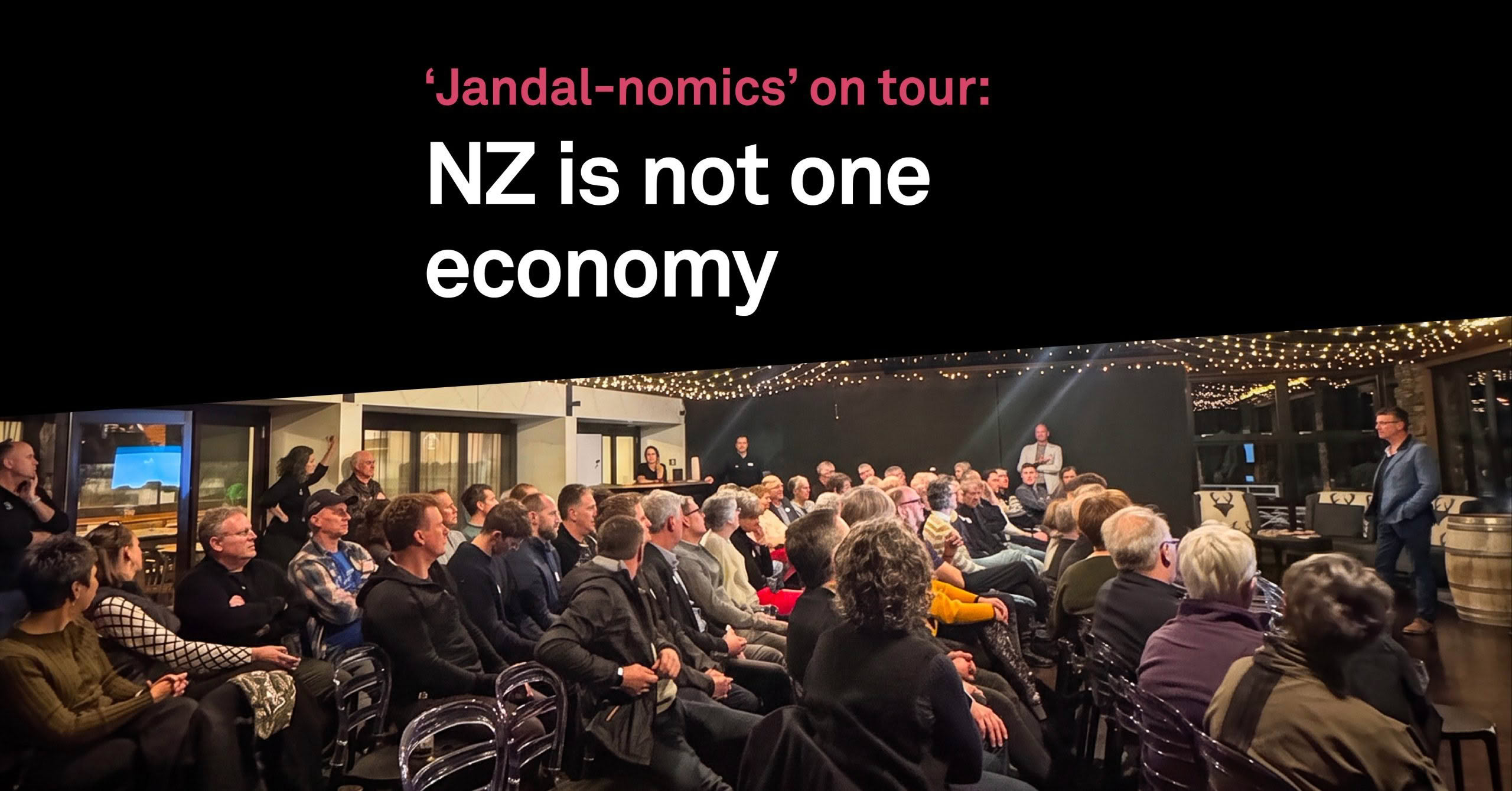
Over recent months, Sidekick has had the privilege of travelling around the country with independent economist Cameron Bagrie.
Our Jandal-nomics events brought together business owners, farmers, clients and members of our wider communities in Otago, Canterbury and the Wairarapa. The economic themes were national and international, but the conversations in each room were distinctly local.
There is no single New Zealand economy.
Different regions, industries and communities are moving at very different speeds. There are genuine reasons for optimism, but also some major challenges that New Zealand cannot continue to avoid.
Geography: one country with several economies
Cameron’s view was that the recovery is increasingly being driven from the South and moving upwards.
Canterbury and Otago are showing strength. Agriculture and other productive industries are generating income, confidence and activity. This is not simply another recovery built on borrowing more money and spending it through the housing market. It has more of the characteristics of an income-and-growth recovery.
The Wairarapa told a similarly interesting story.
Cameron described Wellington as an economy of two halves. Central Wellington continues to face significant issues, while Greater Wellington and the surrounding rural economy are considerably stronger. The Wairarapa is benefiting from productive industries and a comparatively resilient rural sector, even while the central city is dealing with falling activity and the effects of public-sector meddling. Cameron spoke about “Local and National Government just getting to the ‘zero line’ – get out of the way! Just don’t **** it up!”
Where these differences matter, a national headline can say the economy is weak while a rural business is having one of its strongest years. Equally, a strong export return does not automatically flow through to every retailer, construction firm or professional service business in the nearest city.
Business owners need to understand both the national picture and the economy immediately around them. Looking at both macro and micro.
Economy: throw out the old playbook
For three decades, New Zealand operated through what Cameron called the “great moderation”:
Low inflation, cheap money, growing globalisation, rising house prices and a general expectation that the economic system would continue moving forward.
Cameron’s message was that this period is over.
We are entering a world of greater volatility, geopolitical tension, demographic pressure, energy insecurity, inflation risk and changing trade relationships. Artificial intelligence will create enormous opportunities, but it will also disrupt established industries and jobs.
That may sound confronting, but Cameron was not delivering a doom-and-gloom message.
As he said throughout the tour, “This is where the fun happens.”
Volatility creates risk, but it also creates opportunity. Businesses that stay close to their numbers, make decisions quickly and remain disciplined can take ground from competitors who are slower to respond.
That creates an important change in emphasis. This may not be the time to focus solely on growing the overall revenue. It may be the time to focus on winning market share.
The businesses that gain ground over the next few years may not be those with the biggest plans. They may simply be those that execute better, understand their customers and make clearer decisions.
Productivity: the number New Zealand cannot ignore
Perhaps the most damning statistic discussed during the tour was New Zealand’s productivity performance.
Depending on the precise period and measure used, New Zealand’s labour productivity has increased by only around 0.3% to 0.4% a year over the past decade.
What does productivity actually mean?
At its simplest, productivity measures how efficiently we turn inputs into outputs. Labour productivity is generally measured as the amount of real economic value produced for each hour worked.
It is not about asking people to work longer hours or run faster. It is about producing more value from the same amount of time—or producing the same value with fewer resources. Better technology, improved systems, stronger management, investment in equipment, staff capability and removing unnecessary barriers can all increase productivity.
To put New Zealand’s performance into perspective, labour productivity in the United States nonfarm business sector was 2.9% higher in the March 2026 quarter than it had been a year earlier.
That is not a perfectly like-for-like comparison because the two countries define and measure their productive sectors slightly differently. However, it still provides a sobering sense of scale.
On Cameron’s 0.3% benchmark, the United States achieved close to a decade of New Zealand’s recent productivity growth in a single year.
That is a horrible statistic for New Zealand.
Productivity is ultimately what allows businesses to pay higher wages, remain internationally competitive, invest in better technology and generate the tax revenue needed to support healthcare, education, infrastructure and other public services.
Without productivity growth, increasing incomes becomes much harder. We either work more hours, add more people, take on more debt or accept lower living standards relative to the rest of the world.
Farmers are showing what is possible
When we scratch beneath the national average, the picture becomes even more revealing.
Using Stats NZ’s annual industry figures, labour productivity in agriculture increased by an average of approximately 2% a year between 2017 and 2025.
The annual results naturally move around because farming is affected by weather, commodity prices, production cycles and other conditions. But the underlying trend is clear: farmers have continued finding ways to produce more value from their land, labour, equipment and technology.
Our farmers are doing an excellent job. They are investing in genetics, technology, irrigation, systems, data and better on-farm practices. They are adapting to changing regulations, environmental expectations, labour shortages and volatile international markets.
It also brings us back to Cameron’s challenge around the zero line: Can we get out of productive businesses’ way and let them do what they are good at?
If agriculture is achieving productivity gains of around 2% a year while New Zealand’s overall measured-sector average is only around 0.3% to 0.4%, the maths is uncomfortable.
It means significant parts of the economy must be achieving almost no productivity improvement, or going backwards, to drag the national average down so substantially.
This is not about criticising individual workers, New Zealanders work hard, it’s about the systems around them.
Where we invest, the quality of our infrastructure, the technology businesses can access, management capability, regulation, access to capital and whether our institutions make it easier or harder to get things done.
We should be studying the industries that are successfully lifting productivity and asking what can be learned from them.
Unless New Zealand finds a way to produce more value from every hour worked and every dollar invested (Return on Capital), our wages, public services and standard of living will continue falling behind the countries that we compare ourselves.
Banking: taking real risk for real return
One of Cameron’s strongest challenges was that New Zealand needs to become more comfortable with taking real risk for real return.
“We have more road-cones than sheep! We don’t know how to manage risk”
That raises a difficult question about our banking system.
Banks frequently talk about backing business but many business owners find that lending still needs to be supported by residential property. The bank may be lending to the company, but the ultimate security is often the owner’s home and personal guarantee.
Reserve Bank data illustrates the wider structural shift. In June 2026, housing lending stood at approximately $400.5 billion, compared with $143.2 billion of business lending and $64.5 billion of agricultural lending. Excluding personal lending, that means housing represents roughly 66% of lending across those three categories, while business and agriculture account for around 34%.
Using the same Reserve Bank series, the comparable split in mid-1998 was approximately 53% housing and 47% business and agriculture. Nearly ½ and ½ rather than 2/3rds 1/3rd, the balance has shifted heavily towards housing.
This matters because New Zealand will not lift productivity simply by selling increasingly expensive houses to one another.
We need capital flowing into businesses, farms, technology, equipment, exports and people. Those investments carry more genuine commercial risk than lending against an established house, but they are also where sustainable productivity and higher incomes come from.
That does not mean banks should lend recklessly. It means businesses, advisers, banks and policymakers need to find better ways to assess productive opportunities and share risk.
Cameron’s business Chaperon works directly in this space, helping businesses improve their bankability, understand their lending structures and negotiate more effectively with financiers.
Education: today’s classrooms are tomorrow’s economy
Another powerful theme was education.
Cameron described school attendance as potentially one of our most important future economic indicators.
That makes sense. Tomorrow’s workforce participation, productivity, innovation and social outcomes are being influenced by what is happening in classrooms today.
Attendance improved nationally in early 2026, but the regional differences remain significant. Otago recorded the country’s highest regional attendance rate in Term 1 at 73%, with Canterbury and Southland close behind at 72%.
That is encouraging for the South, but it should not create complacency. New Zealand’s overall attendance and educational performance still need considerable improvement.
Cameron said when he talks about Educational stats in Gisborne and Northland, “it’s about as cheerful as a coroner’s retirement speech”.
Education is not simply a government or school issue. It affects employers, families and communities. Businesses will eventually feel the consequences through workforce readiness, basic skills, resilience and the availability of capable people.
An economic strategy that ignores education is not really an economic strategy. We spent twice as much on untargetted winter energy subsidies than we did on helping the children in need achieve beter educational outcomes.
Politics: what a difference a few months can make
When we began the tour, Cameron’s assessment was that the current National-led coalition appeared more likely than not to return to government.
The political mood now looks considerably less certain.
The July Ipsos New Zealand Issues Monitor surveyed 1,002 adults and found Labour was perceived as the party most capable of managing all five of New Zealanders’ leading concerns: cost of living, healthcare, the economy, housing and unemployment.
Labour also overtook National on economic management, with 34% selecting Labour and 30% selecting National. The Government received an average performance rating of 4.1 out of 10, with 24% giving it a positive score of seven or higher.
It is important to be clear: the Ipsos Issues Monitor is not a party-vote poll, and it does not tell us who will form the next government.
However, it does reveal a meaningful change in public perception. Labour is now being credited with greater capability across the issues that New Zealanders say matter most.
That is especially interesting from our perspective. Many people within our immediate business network would traditionally lean towards National or ACT. It would not be unusual for perhaps 80% of a room of small business owners to sit somewhere around the centre-right.
Are those people genuinely moving left?
We would be interested to hear what our clients think.
One July Taxpayers’ Union-Curia party-vote poll had Labour narrowly ahead of National, at 31.5% to 30.5%, but still projected the current National–ACT–New Zealand First coalition to retain a narrow parliamentary majority.
The same poll had approximately 38% of decided voters supporting parties other than Labour or National.
It would be too simplistic to describe all of that support as extreme. What it does show is a more fragmented electorate.
Our suspicion is that some disappointed National voters may not necessarily cross directly to Labour. They may move sideways towards ACT, New Zealand First or the Opportunity Party—or simply become less engaged.
That creates a real challenge for National. Negative coverage surrounding Christopher Luxon’s recent comments with small business owners may weaken its traditional support among that audience, but losing those voters does not automatically strengthen the centre-left bloc.
This election may therefore be decided as much by the movement between parties on the same side of the political spectrum as by voters crossing from right to left.
Why Sidekick hosts these events
For Sidekick, these events are about much more than hearing an economic presentation.
Our mission is to help our clients be more successful, and bringing people together is an important part of that.
We are a people-driven organisation. We want our clients to understand what is happening beyond their own businesses, meet other people facing similar challenges and leave with ideas they can use.
Over the coming year, we will continue sharing Cameron’s thinking with our clients and communities. We are also looking forward to taking to the road again next year with another Roadshow.
Keep an eye out for upcoming Sidekick events, and please reach out to your Sidekick adviser to discuss what these economic, financial and regional changes could mean for your business.
Thank you, Cameron
A huge thank you to Cameron for his energy, openness, humour and outstanding effort throughout the tour.
Cameron has a rare ability to turn complicated economic information into practical, straight-talking insights that people can understand and act on.
You can follow his economic analysis through Bagrie Economics, which provides independent economic research, presentations and strategic advice.
Cameron is also involved with Chaperon, supporting businesses to become more bankable and navigate their financing relationships, and Equity Release NZ, which provides independent information about equity-release and reverse-mortgage options.
We are in a fascinating, and occasionally uncomfortable, economic period.
The old playbook may no longer work. But for disciplined, informed and adaptable businesses, there is still plenty of opportunity ahead.
One final note that might make you smile, Cameron thinks that Aussies are in for a shocking couple of years and New Zealand will gain a lot from that! That will teach them for that under-arm bowl!
Thank you for your interest in this article if you got this far!
Ric Thorpe
CEO